VALENTINA GERVASONI
Que este mundo permanezca (May This World Remain) is the title of your project, and it immediately evokes a reflection on preservation and coexistence. Could you tell us how this work originated and how it developed?
MERCEDES AZPILICUETA
The project was commissioned by GAMeC, with the aim to develop a performance in the public space and immersed in nature. It started at the beginning of 2024. For me, it meant returning to my performative practice, developing work in nature, and collaborating with local performers and makers. I liked the challenge of making for nature as well, as it seemed that we would be performing for the birds, the trees, the waters at the Biodiversity Oasis in Brembate. At that time I was reading Becoming Animal: An Earthly Cosmology (2010), a book by David Abram that caught my attention right away because of the enormous space that was being reclaimed for everyone, beyond humans. I also remember a long correspondence I was having with Argentine filmmaker Andrés Di Tella on birds and migration. Andrés was working on his film and we exchanged many thoughts on birds. My work is directly connected to what I am reading and having conversations about. The idea of embodying birds for a performance was directly related to these encounters. I was needed to return to performance. I wanted to focus more on the body, its senses, its beyondness, and to get out of the gallery or museum as well. Performing in nature and for nature meant a whole new world where different senses needed to be activated and where not everything could be controlled. That sense of contingency felt necessary and urgent.
VALENTINA GERVASONI
The Brembate Biodiversity Oasis, where you realized the project, is a very particular place—an industrial site for sand and gravel extraction that has been transformed into a natural area through a long process of environmental remediation. Today, the site hosts important conservation activities, such as monitoring water quality, and also functions as a space for study and research—for example, tracking the bird species that have returned to inhabit the area. This represents a profound transformation of the landscape, from an extractive site to a place of biodiversity. What role did this context play in the development of your project?
MERCEDES AZPILICUETA
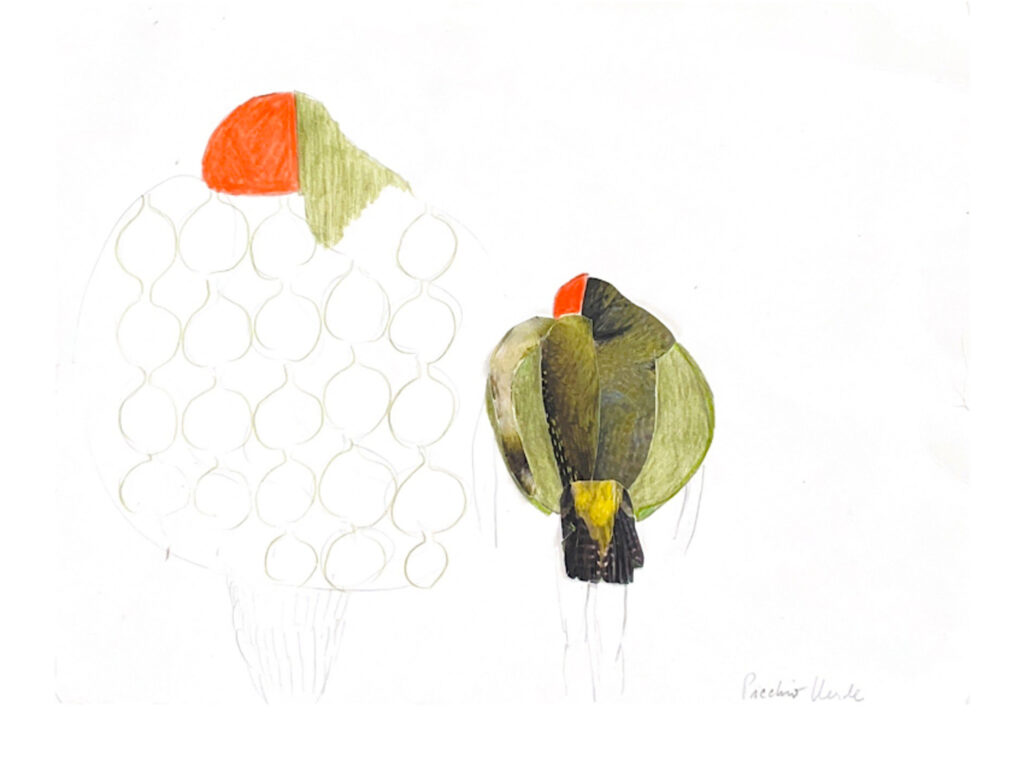
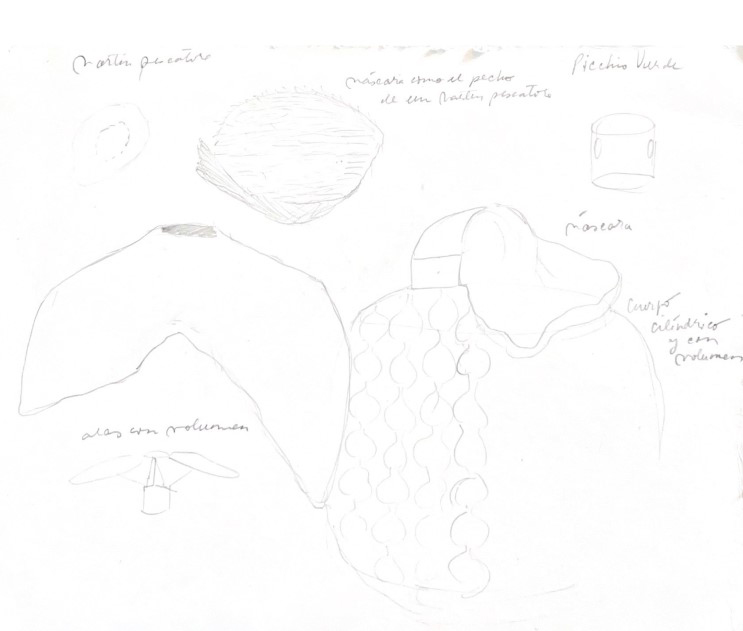
This particular place, and its capacity to keep transforming, influenced the work in many different ways. On one hand, the idea that there is a form of restoration happening in the ecosystem had a strong connection to the performance. The different movements and choreographies along the way had to do with beings trying to readapt to a new environment. On the other hand, we worked with repurposed materials for the costumes. I collaborated with local costume designer Alberto Allegretti, with whom the costumes became a kind of ode to regenerative ways of making wearables and performance garments.
VALENTINA GERVASONI
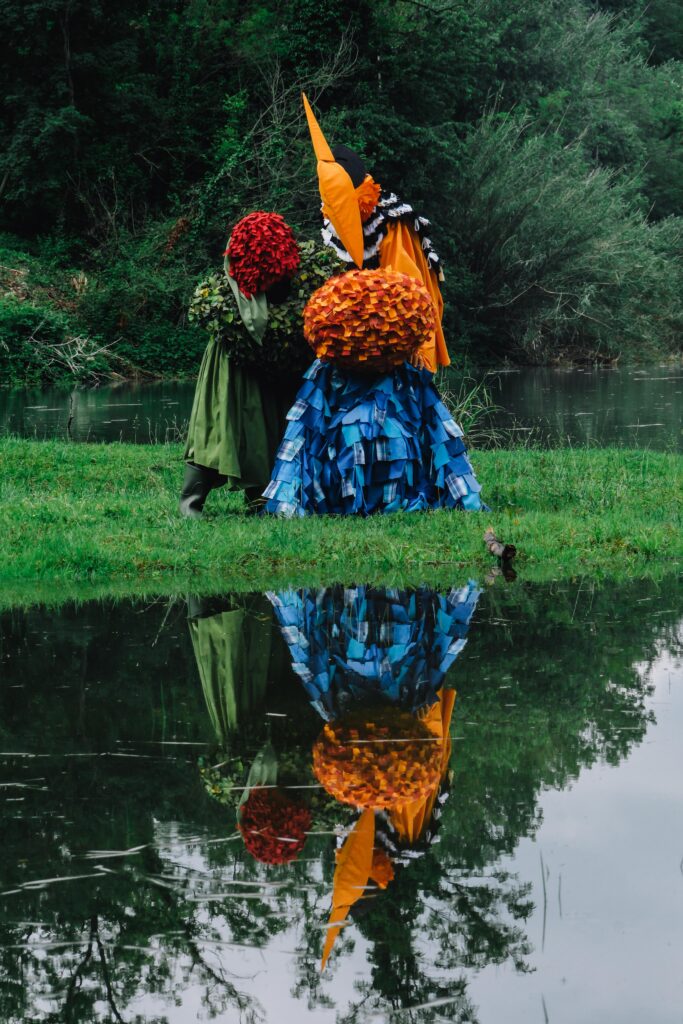
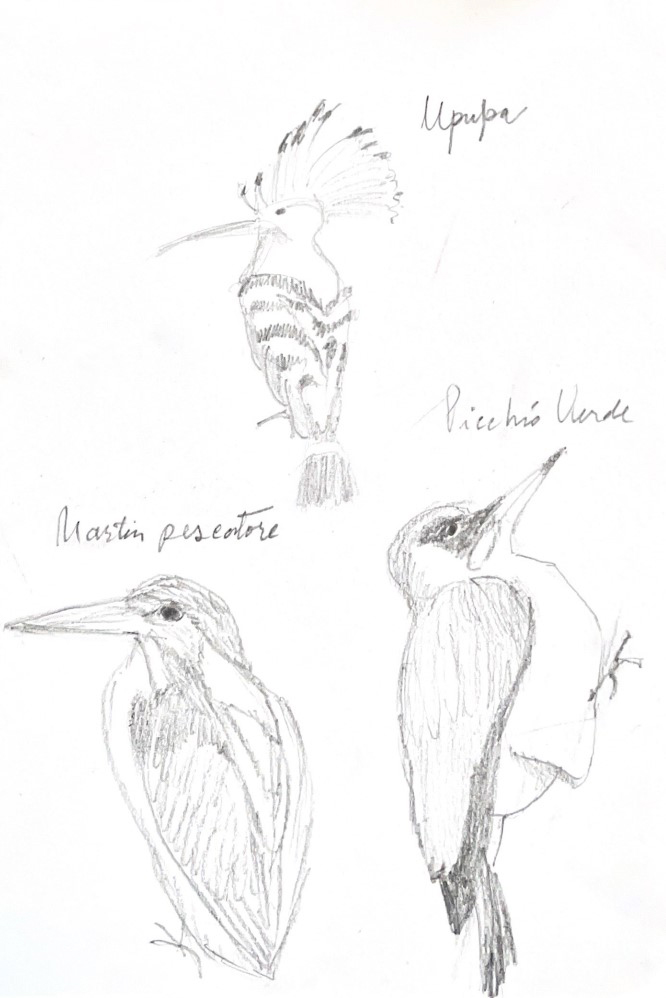
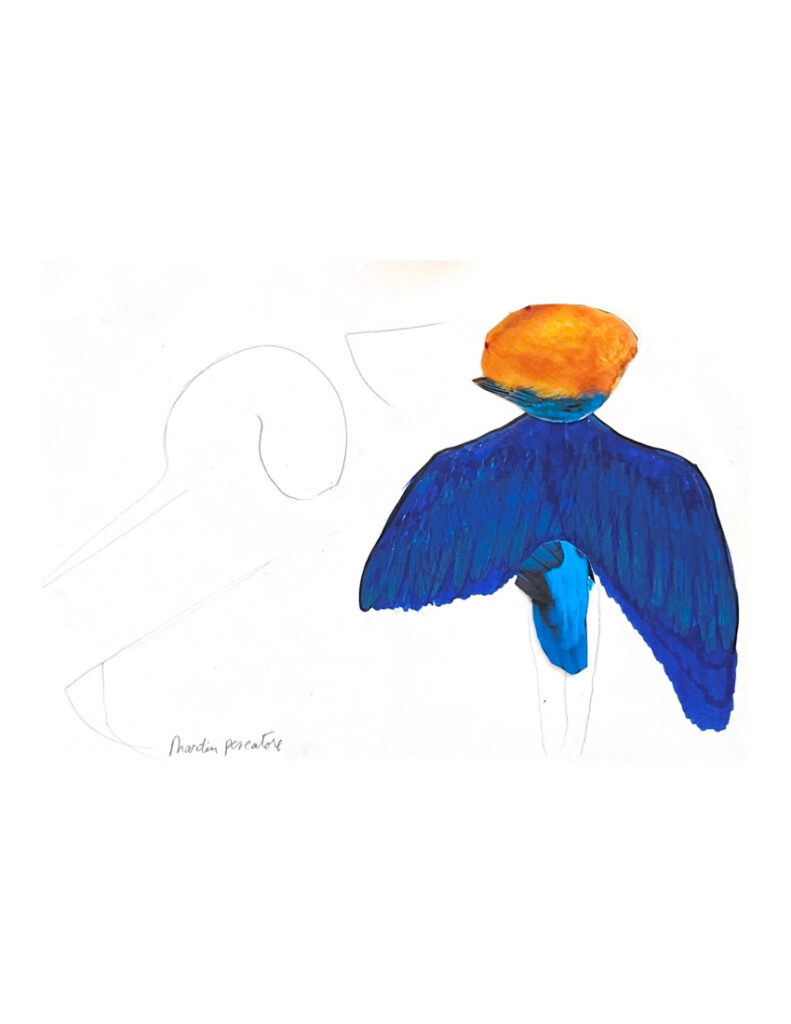
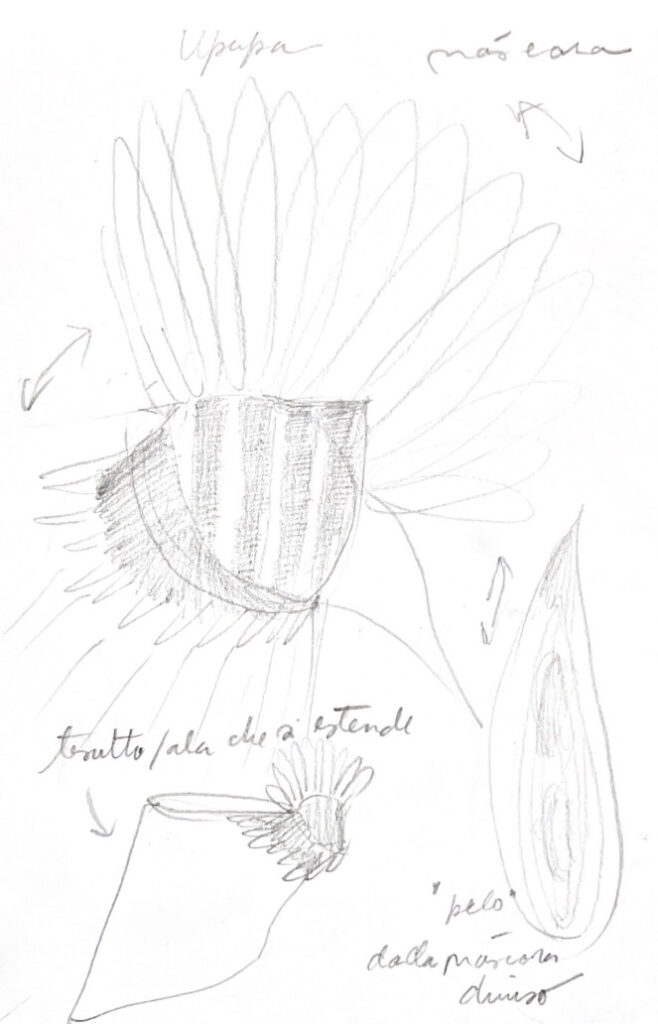
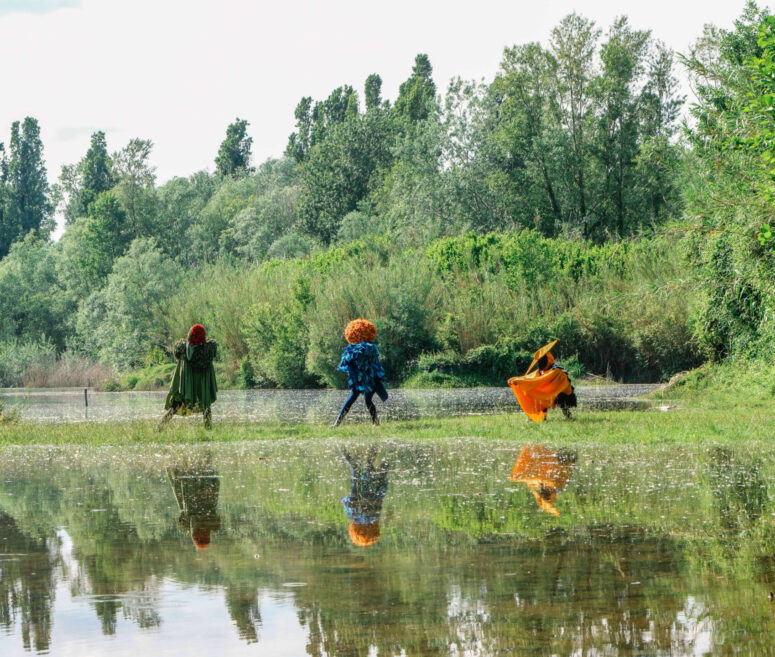
Que este mundo permanezca took shape through collaboration with other participants—first and foremost the performers, whose movements were attuned to those of birds, and the costume designer, who created the costumes that made it possible for the performers to transform respectively into a kingfisher, a green woodpecker, and a hoopoe. Could you describe what it was like to work side by side with these professionals and how you developed the choreography and the costumes? What role do collaboration and exchange with others play in your artistic practice?
MERCEDES AZPILICUETA
My interdisciplinary and collaborative work feeds off the intersections between practices and from exchanges with the people I choose to work with. In those intersections, there is room to push the limits or contours of our own ways of doing things, our own methodologies. I always like to keep a beginner’s mind when working, because that allows me to have a more playful approach to making. I also like to collaborate with people and fields I can learn from.
In this case, I worked with my long-term collaborator, Antonella Fittipaldi, and with local dancers Aurora Rota and Nicola Forlani. The costumes were also made in collaboration with Alberto, as mentioned before. From each of them, and through collective discussions we arrived at the performance. I find it important to listen to the people I collaborate with, to observe how they interpret my suggestions or tentative script, which is very much developed based on their competencies and gifts. In a way, it is a tailor-made script according to what I encounter in those first meetings. And then I like to keep it open, so that it continues to transform and evolve.
VALENTINA GERVASONI
In your work, the body and movement take on a narrative, expressive, and perhaps even ritual function; they serve to articulate stories, roles, and power relations, and to generate collective moments. In the Brembate project, movement is connected to birds and to the landscape of the Oasis. What does it mean for you to place bodies—both human and non-human—at the center in this case? More generally, how do you conceive of and develop corporeal language in your performances?
MERCEDES AZPILICUETA
I think it is an alternative way to imagine how this world could continue to exist, by removing ourselves, as human beings, from the center of the discussion and by starting to connect, in an embodied way, with other beings and things that surround us. I like to think with gestures, to bring spontaneity and wit into the movements. I like them to lure the viewer into the scene; there is a combination of sensual senses, humor, and narration. Another important feature of the choreography is repetition, which I have been working with from the very beginning of my performative practice, when using language in performances such as Yegua, yeta, yuta (2015) or bigger projects like Bestiary of Tonguelets (2017–21). In this last project, for example, I worked on a video about the power of the ruda plant, where actress Emmanuelle Lafon accentuates the magical and protective powers of this plant by repeating certain words and spells related to it. In previous performative works, like Molecular Love (2016), I have investigated repetition as a way to distill affects in relation to the political dimension of female desire, beyond its reproductive function. There is a strong force stemming from repetitive movements, gestures, and words; I believe it is somehow linked to materialization. And this repetition is beyond the mechanical, it really opens up a space for the unexpected. We could perhaps better talk about recursiveness.
VALENTINA GERVASONI
In your practice, costume recurs as a device for rethinking identity and transformation. What symbolic function does it assume for you, and how does it help to construct spaces of imagination, subversion, or resistance? How do you understand masking and disguise in relation to the performative body and the possibility of giving voice to other subjectivities—human, animal, or imagined?
MERCEDES AZPILICUETA
Costumes, wearables, masks, and props all help to make the practice, and my own personality, something that cannot be contained. By allowing all these gadgets and prostheses to enter my own body and the bodies of others, I reimagine other personalities, other ways of being and doing. I strongly believe in the capacity to constantly reinvent ourselves, as I question the myth of a single, fixed identity. I think I have been deeply influenced by the work of Leonor Fini, an Argentinean-born Italian artist who had a magical connection to cats. I remember researching her life and work while I was living in Milan in 2017–18, and seeing all those photos with her costumes, feathers, cat-like masks, and drawings she made for the La Scala opera house in Milan had a profound impact on me. Fini’s imagination, her capacity to create new scenarios, worlds, and, above all, the audacity of her life, is something inspiring and tied up with the idea of reconfiguring the notion of “one” identity, “one” body, and our relation to animism.
VALENTINA GERVASONI
A recurring line of inquiry in your research concerns migrations—of humans, animals, or plants—triggered by historically rooted dynamics of colonial and patriarchal power. The very nature of these migrations compels a necessary reflection on the concepts of borders and the nation-state, undermining their foundations. In Living as a Bird (2019), Vinciane Despret, associate professor of philosophy at the University of Liège, suggests that birds are constantly engaged in processes of deterritorialization through movement, nest building, the negotiation of social relations with other individuals of the same or different species, and changes in the use of space. Despret’s position follows the line of thought developed by Deleuze and Guattari, for whom territories are not static or fixed entities but dynamic and fluid processes that continually involve the creation and re-creation of spaces and boundaries. This can occur through a variety of processes such as migration, the invasion of new territories, political or cultural resistance, or the transformation of social relations. Deterritorialization can lead to the destabilization of preexisting boundaries and to the emergence of new forms of spatiality and belonging.
In Que este mundo permanezca, the point of view is that of three different bird species that inhabit or pass through the Oasis and indirectly call into question traditional, anthropocentric conceptions of territory. What aspects of the kingfisher, the green woodpecker, and the hoopoe struck you most? Which traits of their adaptive capacities guided your work?
MERCEDES AZPILICUETA
In previous work like Bestiary of Tonguelets and The Rebellious Garden, I have focused on subjects like natural latex or botanical gardens, symbols or expressions of a colonial history made of invasion, extractivism, and arbitrary borders, a patriarchal and male-centered history I tend to question by counter-telling collective knowledge linked to ancient practices. The interest I take from collective knowledge and obsolete practices is directly linked to premodern times, where the commons belonged to the people and borders and territories were something more fluid and less demarcated. I see Despret’s work on birds and her thinking around de-territoriality as a great interlocutor for this work. De-territoriality is closely linked to the body and the politics of the body. I can think of Silvia Federici and her book Caliban and the Witch or better, Milanese philosopher Luciano Parinetto and his book Alchimia e utopia. There is a beautiful essay by Simone Frangi in the book of Bestiary of Tonguelets that I published with K Verlag in 2024, where he describes Parinetto’s work in relation to the outcasts in premodern times and how the way these people were persecuted (and murdered) by the State was directly related to the genocidal methods that colonizers used against the Indigenous people of Abya Yala. The starting of the annihilation of the commons was sine qua non for the making of “states” as we know them today.
Going back to your question, I can briefly describe what type of features from the birds I worked with. From the kingfisher, I took its fearlessness and assertiveness. The movements we used to translate these traits were very direct and bold; we wanted to transmit this energy to the viewers in the simplest way. Performed by Antonella Fittipaldi, the kingfisher also nests by water; its head is big because it is a mental bird. At times it grabs its head, shaking it desperately. The mind cannot digest how fast we lose track of our ancestries and organizing structures. The green woodpecker, performed by Aurora Rota, is a shy bird and an important seeker of suitable environments to thrive. It guides the public through pastures and small forests, showing how to survive, what to eat, where to take refuge. Lastly, the hoopoe, performed by Nicola Forlani, presents itself as superstitious while at the same time sensing climate grief. With its undulating flight, it lures the public into the reeds, and through curvy hand gestures and sensual movements, gathers the other birds for a ritual by the waters. Throughout the itinerary, the hoopoe and the kingfisher also speak to each other, singing a duet from opposite shores of the lake.
VALENTINA GERVASONI
According to Despret, birds do not simply inhabit a physical space; they are also involved in a series of activities and behaviors that contribute to defining and maintaining their territory—for example, through song. For Despret, song has a highly complex function: it is an extension of the bird’s body into space, and in this sense, within a dynamic of reciprocity—appropriating a place means shaping it to oneself while also being shaped by it. From this perspective, territorialization is less an act of turning space into something one owns than an expression of oneself.
From its very title, your performance suggests a reflection on the conservation of the natural environment, in which the concept of “world” can be interpreted as referring to biodiversity or to the harmonious coexistence between human beings and their environment. By focusing on the stories and perspectives of birds, you invite us to embrace a plurality of voices and experiences within the animal world, challenging anthropocentric and privileged conceptions of the human as the center of meaning and value. In what ways does your practice help us imagine new worlds, or a more habitable one?
MERCEDES AZPILICUETA
I think it happens through the use of narrative, which I borrow from literature and poetry. I am thinking, for example, of South American poets such as Circe Maia, Idea Vilariño, Juan L. Ortiz, or Laura Wittner. It also comes about through storytelling, humor, and the use of history, as well as what I call “irreverent” research—that is, artistic research that is less formal and less beholden to any single scientific discipline. All of these elements help to recreate and retell our lives and our ways of living. Alongside speculative fictions there are images, which support the use of a radical imagination and the pursuit of social and ecological justice through an interdisciplinary and collective practice. For all of this, I also draw on the use of regenerative materials and practices.
Next to that, and from a chronopolitical point of view, working with time allows me to reassemble a story or piece of history the way I think could be told or revisited today. Time, in the linear sense, is one of our best constructions and contesting it is crucial for us in order to reinvent and mend our worlds. I work a lot with atemporal synchronicities because I don’t believe in linear time. I would go crazy if I had to adhere to the world we were told. For me it is important to bring circular narratives, unexpected synchronicities, the future into the past and vice versa, weird material ensembles and wild interdisciplinarity among others. Only by messing around (and disobeying) with what has been told, we can carve out “new” alternative and desired spaces (and times) for us. Only through imagination will we be able to restore and reclaim our present and our past, as well as reinvent the future we desire.