
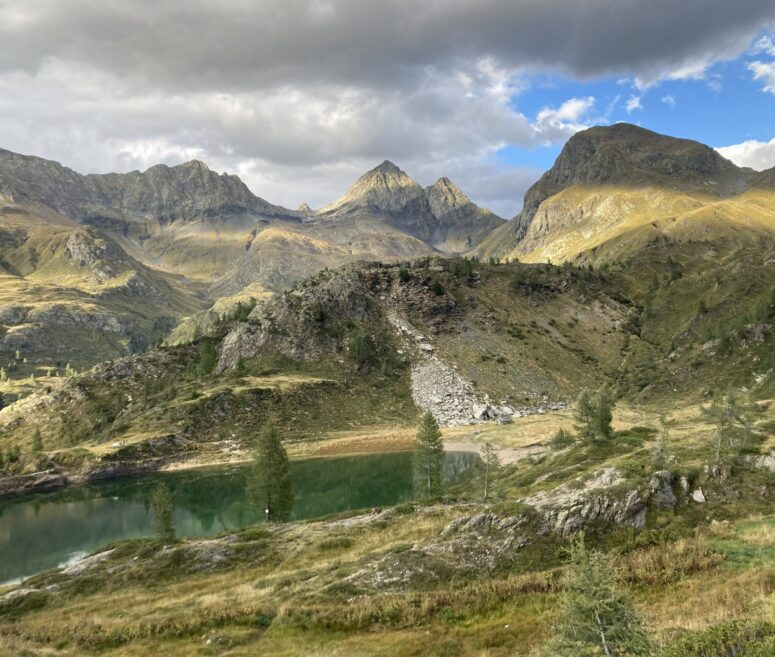
Anticipating many of the modern-day ecological preoccupations—even if he was a white man of the early twentieth century, and so still shot-through with a thoroughly anthropocentric culture—Leopold invites us to move from a mechanistic to an organicist model, from an extractive vision towards a regenerative one, from a fragmented time to the long term. As the author put it, “only the mountain has lived long enough to listen objectively to the howl of a wolf”. Only the perspective of the mountain, with its depth of time and of geology, can help us to understand the ultimate reasons for the existence of the wolf and can offer us a yardstick for grasping the deepest sense of our living together.
In the trajectory of the Orobie Biennial, Leopold’s book served as a conduit for the desire to adopt a multi-focal viewpoint on the land in which we live and on what we do there. It is a view that is at once close-up—as necessitated by the practice of walking—and “from a certain distance,” being the physical and geological distance from which the mountain teaches us to look. If, for Leopold, “thinking like a mountain” meant appreciating the deep interconnectedness of the elements of the ecosystem—an invitation to contemplate nature and its creatures as an organism blessed with equilibrium, harmony and beauty, on which our own integrity and health depend—during our journey his story embodied the attempt to conceive of ourselves and to act as a collective body, as an organic, multi-species system; one capable of combining a more conscious thinking-in-the-round with an imaginative, creative, and adventurous form of local action.