

VALENTINA GERVASONI
For the creation of Rien ne pourra nous séparer, you had the opportunity to explore Bergamo’s natural and cultural heritage, starting with the Lorenzo Rota Botanical Garden in Città Alta. Among the species rooted in the urban landscape of Bergamo, you recognized the acanthus, a perennial herbaceous plant that also grows spontaneously in Tunis, your hometown. Could you tell us more about how this project was born? Was there a specific episode, image, or encounter that sparked the idea and encouraged you to begin this research?
YESMINE BEN KHELIL
During a previous project, when I was focusing on plants that grow spontaneously, I came across a quote that struck me. It recounted the fable of the invention of the Corinthian capital by Callimachus:
The artist was wandering through the countryside, perhaps thinking of his many works; he stopped, moved, before the tomb of a child—a simple stone upon which a mother’s compassion had placed a basket full of fruit. But, so that the birds of the sky would not come to devour the offering reserved for the dear departed, a tile had been placed on the opening of the basket. However, an acanthus, sprouted there, had grown, and its flexible stems, blocked in their ascent by the rough terracotta, had curved into spirals.
(This is a quote by Albert Jacquemart in Les merveilles de la céramique, cited by Louis Aragon in Henri Matisse, Roman.)
The fact that the presence of the acanthus on capitals was purely coincidental and that its creation was linked to a story of mourning and burial was something that already interested me deeply. So, when I found it in Bergamo, I thought it was a happy coincidence and the right opportunity to explore further. The idea of one fable generating another, but also of creating links between my new works and earlier ones is something I often do, even if I don’t always make it explicit.
VALENTINA GERVASONI
The acanthus is a plant that carries with it a rich mythological and popular tradition that converges in Rien ne pourra nous séparer. The stories connected to it intersect with a series of further heterogeneous trajectories: from classical myth to botany, from Mediterranean stories to the popular songs of Sayed Darwish. Can you tell us more about these references? In particular, how Darwish’s music began to dialogue with the other elements, and how these seemingly distant worlds found a meeting point and conversation in the imaginary you constructed.
YESMINE BEN KHELIL
It was through a documentary on the Egyptian architect Hassan Fathy (Il ne suffit pas que Dieu soit avec les pauvres [It Is Not Enough for God to Be with the Poor] by Borhan Alaouié and Lotfi Thabet [1978]) that I encountered the words of a song by Darwish:
The flowers of the garden have blossomed. From them arise different scents. And yet the plants are born from the same soil. And the seeds sown have been watered with the same water. I wonder, I wonder: how is it possible that, from two branches born from the same plant, one creeps and buries itself, while the other gushes forth and blooms?
Through this analogy, Darwish’s song established for me, at that moment, a link between the acanthus and the thought of Hassan Fathy, for whom architecture was inextricably tied to the land and the moving body that inhabits it. To clarify my line of thought: according to Fathy, cement and so-called modern architecture, imported from the West, would create a mental structure that would never allow the inhabitants of the peripheries to gain autonomy from the center, and thus could only reinforce the persistence of inequalities. His revolutionary vision for the time fits into this idea that drawing inspiration from plants and other living species—in their way of inhabiting the earth—is a possible path.
I thought that because of its presence on both the southern and northern shores of the Mediterranean, the acanthus—beyond the narratives it carries—could also evoke the inequalities that characterize the Mediterranean area, and even more so the ambiguity of the current capitalist system that, while creating separations, does everything to ensure that the autonomy dreamed of by Fathy can never be realized. Hence the irony of the title (“nothing could separate us”), which also refers to the fact that the migratory flows of plants as well as humans are, in reality, uncontrollable.
VALENTINA GERVASONI
In your work, you’ve engaged a lot with the body—on the one hand, a body in transformation, and on the other, the body as a space of conflict, seeking to escape patriarchal and anthropocentric control. The concept of metamorphosis has been central in Western thought. Metamorphosis is often described as a process of loss and diminishment; the human being, considered the unsurpassable apex of a predetermined hierarchical order, dissolves into animal, plant, mineral, or even celestial forms, with no possibility of return. However, this vision builds on a long tradition in which the female body is often central to narratives of violation and appropriation, where the woman is frequently a passive object, inscribed in a logic of visual consumption, subjected to the will of male deities, and transformed for punishment, salvation, or someone else’s desire.
Rien ne pourra nous séparer refers to the myth of Acantha, a nymph who did not return the amorous interest of the sun god Apollo. When sexually assaulted by the god, the nymph reacted by scratching his face. In revenge, Apollo turned her into a thorny but sun-loving plant that bears her name. How does Acantha’s metamorphosis represent not only a forced and passive loss of her previous form, but also an active form of reasserting her body in the world? Can the acanthus, as a speculative symbol, serve as a tool to overturn established hierarchies—from anthropocentrism to patriarchy?
YESMINE BEN KHELIL
Yes, I wanted the forced transformation to be perceived almost as a liberation, or even as a pleasure in seeing one’s body transformed. In many stories, as in superhero films for example, metamorphosis first appears as something frightening, but then becomes exhilarating. This oscillation between the fear of the unknown and the pleasure of change is a dynamic I often explore in my work, because it opens up the possibility of perceiving transformation not as a loss but as an intensification.
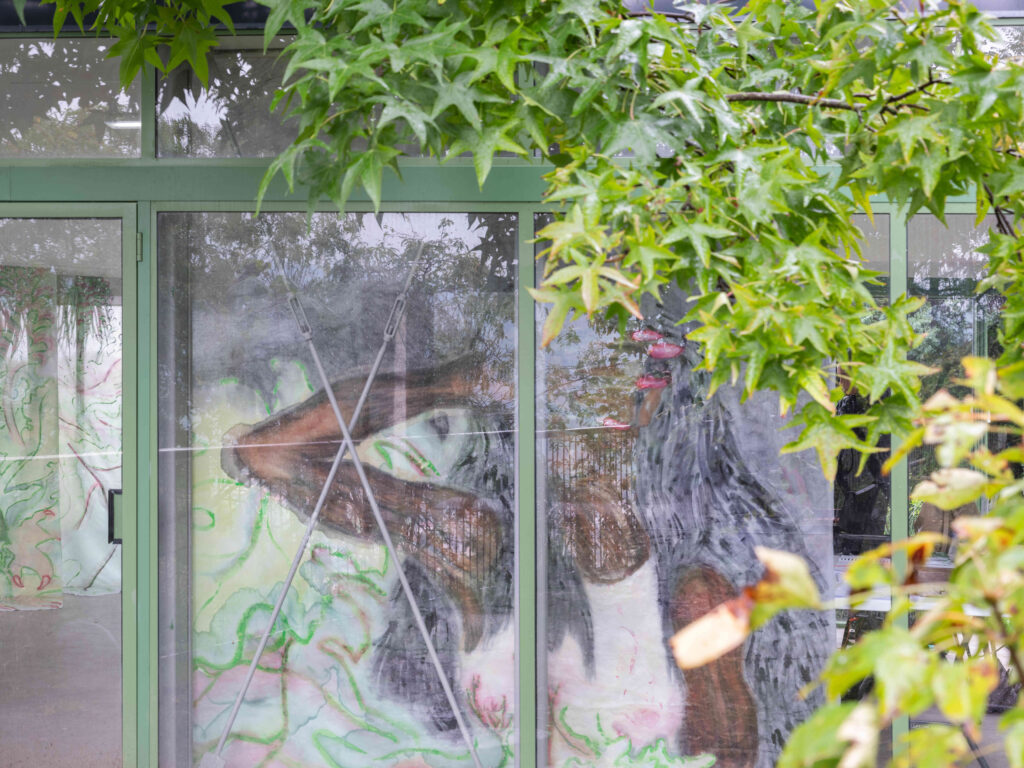
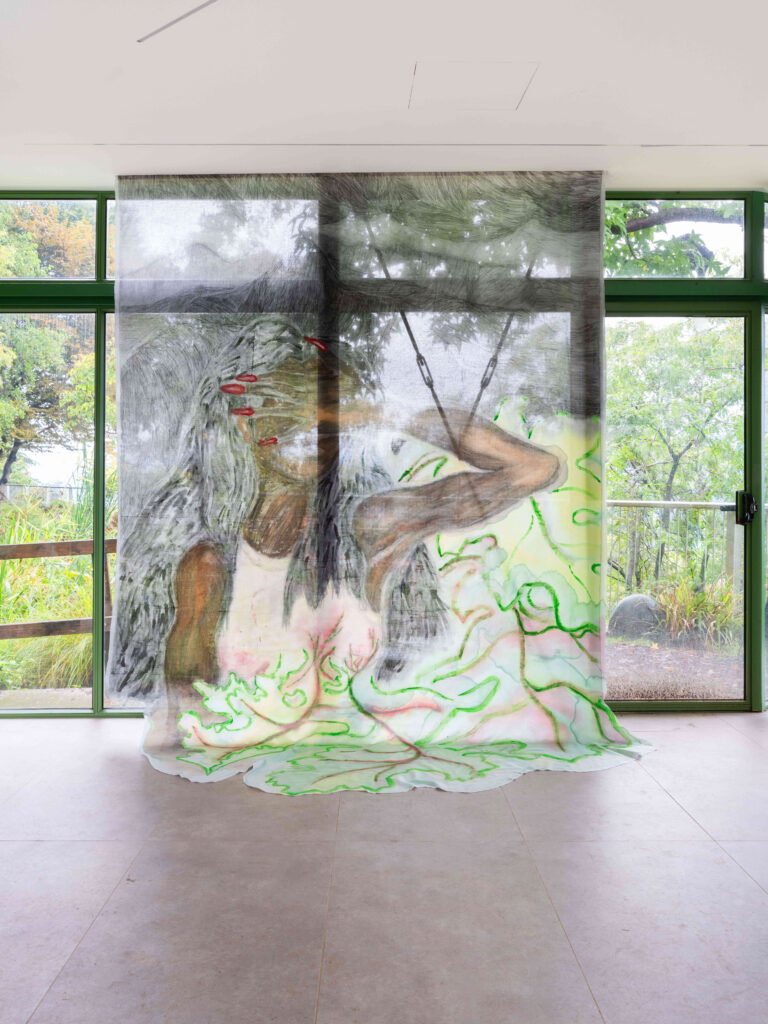
At the same time, I wanted to avoid reproducing the cliché that systematically associates the female body with nature, and that is why I introduced an artificial detail: the fake red nails, which remain visible on the plant after metamorphosis. In this way, the acanthus does not become a “normal” plant, but a hybrid body, at once natural and artificial, that reaffirms its existence and opens a space of resistance against the logics of hierarchy and domination.
VALENTINA GERVASONI
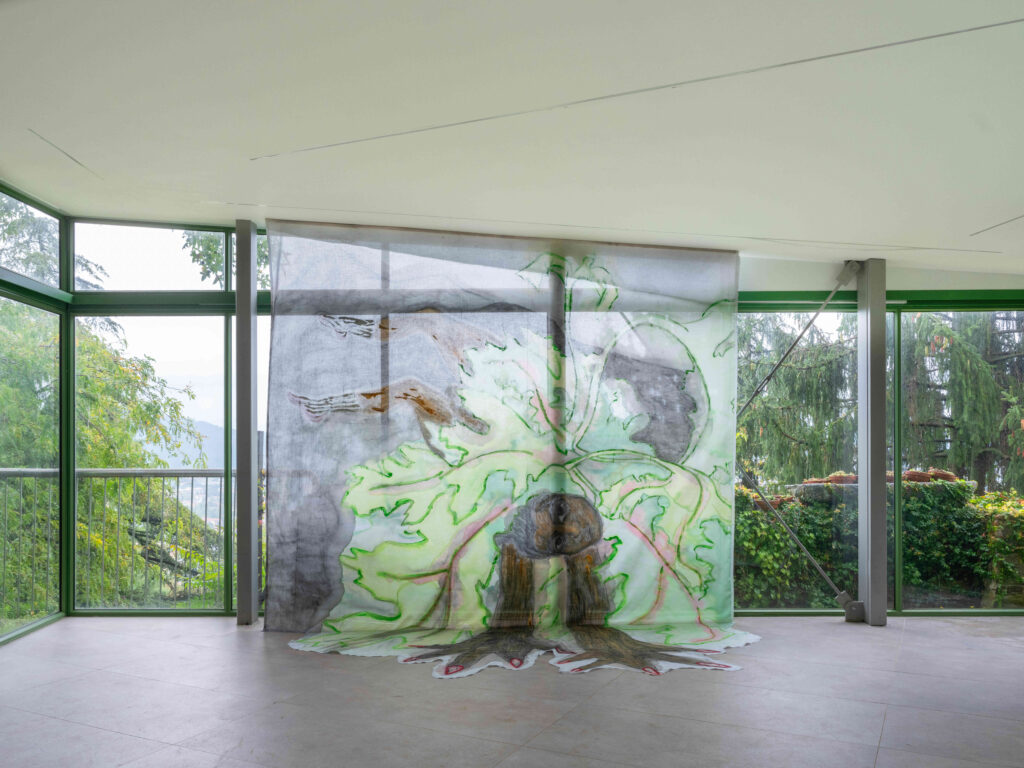
There are precise iconographic parallels that describe this authentic process of hybridization, which subverts the predetermined order between what is human and what is other-than-human: the lacquered red nails tracing the deep incisions that characterize the leaves, reaching as far as the main vein and turning into the spiny edges of the leaves, but also the curly vitality of the hair unfolding in the lobed fronds. Which materials or techniques seemed most suitable to you to convey this ambivalence? The use of transparent canvas and the exhibition setting create continuity between inside and outside. To what extent does this spatial dialogue become an integral part of the discourse on the transforming body?
YESMINE BEN KHELIL
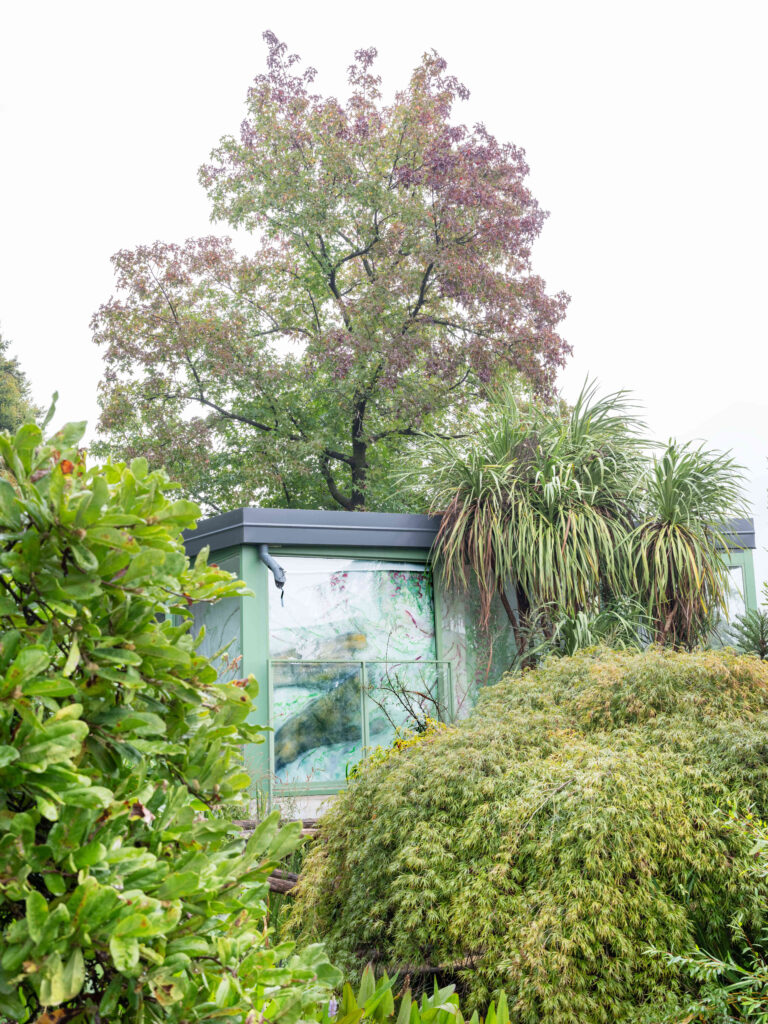
The choice of materials was made primarily in relation to the site: since the Botanical Garden pavilion is glass-walled and widely open to the outside, it was important that light became an integral part of the work, and that the support was flexible enough to react to air currents. I wanted there to be porosity between inside and outside, for the drawing to merge with the landscape and become part of the garden. To convey the ambivalence of the story, it was necessary for the whole to appear fragile, almost vulnerable, yet still immerse the viewer.
VALENTINA GERVASONI
What did it mean for you to work in the space of the Bergamo Botanical Garden, and more broadly in the Bergamo context, in relation to your own background?
YESMINE BEN KHELIL
What struck me most about Bergamo is the omnipresence of nature—but a nature that seems very controlled. Exhibiting in a botanical garden pushed me to reflect on this vision of the nonhuman as a chaotic element that must be controlled, ordered, and preserved. This way of seeing nature has spread; where I live, the lack of means to control and preserve nature creates a state of permanent conflict, in which it is often perceived as a threat or an obstacle. Paradoxically, in this context where nature clandestinely asserts itself against fragile human infrastructures, it becomes easier to perceive that humans are just one element among others in the ecosystem. In Bergamo, the landscape is so well designed that it deceives, and it is only by looking toward the mountains that we can overcome this illusion. I tried to translate this duality into my work.
VALENTINA GERVASONI
Telling stories that intertwine the human and the nonhuman, that bring fiction, memory, and reality into dialogue, can become a way of passing on the traces of lives erased by the violence of the Anthropocene. From this perspective, narration (both visual and literary) is not only an exercise of imagination, but also a form of resistance—a way to create unprecedented bonds, rebuild lasting connections, and embrace the polyphony of voices and perspectives of multispecies existence. In speculative fiction, the multispecies narrative often allows us to recognize signs of crisis (I’m thinking, for instance, of rising temperatures or the scarcity of vital resources in the novels of Octavia Butler and Ursula K. Le Guin) or to deeply understand the crises themselves. In the introduction to Testimone_Modesta@FemaleMan®_meets_Oncotopo. Feminism and Technoscience, titled “Donna Haraway: If the World Is a Dialect Called Metaphor,” Liana Borghi writes:
Metaphors foster the blending of concepts and worlds that appear distant, allowing links to be established between different dimensions and creating bold connections between time and space. Metaphors are tools that allow meanings to slide and shift, capturing subjects that would not fit into the hegemonic system of cultural reference.
In your work, intertwining myth, memory, and geopolitics, you’ve managed to transform your artistic practice into an “ecological” practice—a way of escaping the logics of the Anthropocene and of imagining, and thus constructing, alternative futures where the roots and fronds of the acanthus become symbols of connection on multiple levels. What potential do you see in fiction as a special political language?
YESMINE BEN KHELIL
I think fiction allows us to convey what escapes simple representation, making us perceive the full complexity of reality, which is often elusive and tends to fade when we try to show it directly.
To me, storytelling is an essential part of reality, in the sense that we are all situated within a narrative. It is also a way of approaching the world through the lens of our experience and the attention we give it. So it feels natural that the fables appearing in my work sometimes give rise to others. Stories nourish each other; they shift, evolve, and reinvent themselves depending on the places, contexts, or materials I encounter.
In this way, the thread connecting my projects—which I don’t often make explicit—does not create a unified whole, but rather a fabric of relationships and correspondences. Fiction thus becomes a powerful tool for revealing zones of uncertainty.
For the New Flesh project, for instance, which took the Oceanographic Museum of Carthage as its starting point, the shift into fiction allowed me to render perceptible a truth I couldn’t have expressed otherwise—a genuine attachment to the place, mingled with a deep sense of unease. This unease wasn’t only rooted in the fact that the institution perpetuates the colonial legacy of an anthropocentric worldview, but also in something more latent, almost stale, at the very heart of the state apparatus that this agonizing institution embodies.
VALENTINA GERVASONI
There’s a geopolitical dimension that runs through your work, especially when the acanthus becomes a metaphor for movements, rootings, and conflicts. How has this dimension guided your research?
YESMINE BEN KHELIL
I couldn’t say exactly how, in the sense that it happens quite spontaneously. I always start from the context I find myself in. For example, the fact of moving from Tunis to Bergamo for the development and production of this work necessarily implies questioning this displacement, all the more so since for me it was simple, while for others it can be very complex, sometimes deadly. Let’s say I start from the principle that, as an artist, I myself am inextricably tied to these issues.
VALENTINA GERVASONI
What does it mean to you to experience a real sense of belonging to a place?
YESMINE BEN KHELIL
For me, the sense of belonging is built through all the experiences that connect us to a place: memories, emotional bonds, and the way the external space shapes us internally, until it becomes part of us.
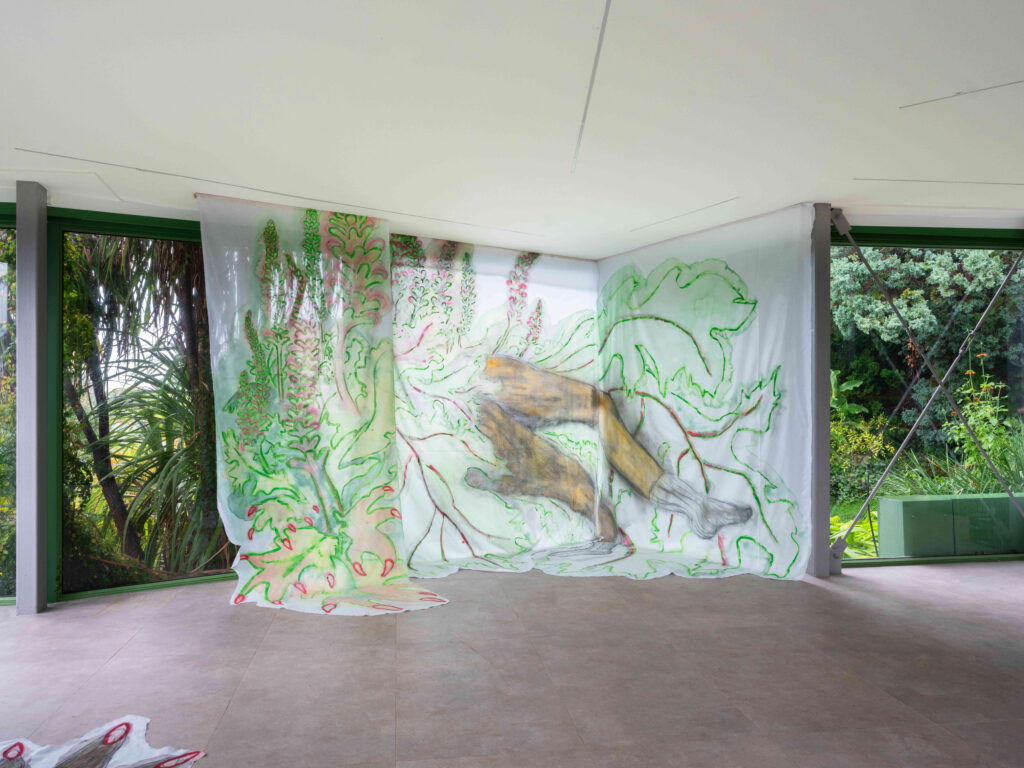
Ph: Nicola Gnesi Studio