
VALENTINA GERVASONI
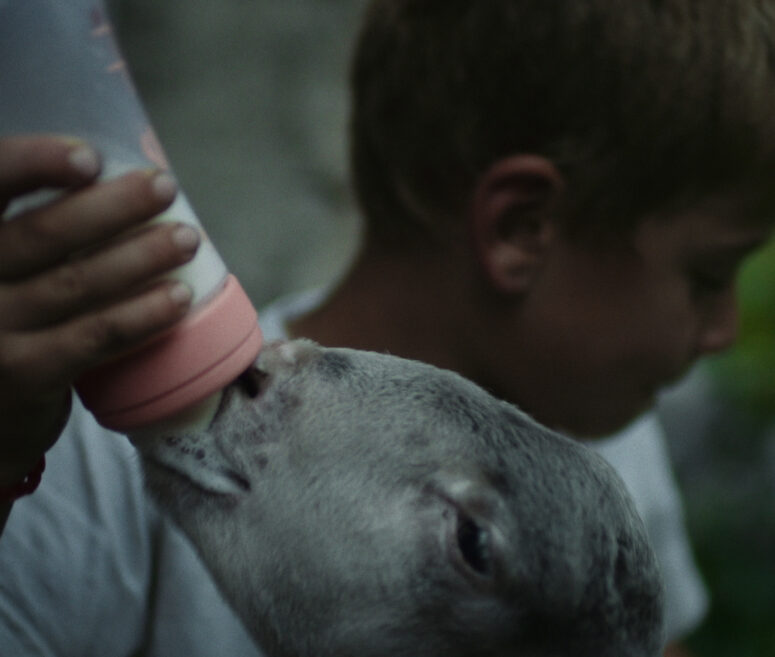
This conversation stems from the desire to explore conscious and non-naïve ways of inhabiting the mountains, far removed from the often stereotypical and conventional idea of alpine environments as idyllic places, natural refuges from the urban hustle and bustle. Our dialogue follows two specific lines of investigation: the short film MUT by artist Giulio Squillacciotti and the design research work of curator Angela Rui. MUT recounts the cyclical nature of life in the mountain pastures and, in particular, the dairy tradition in the Bergamo area through the experiences of two young farmers and their parents: daily lives unfolding through actions and moments that are repeated from dawn to dusk and that highlight both the precocious responsibility of Dario, a thirteen-year-old already in charge of the pasture, and the spontaneous and affectionate gaze of his little brother Omar in his relationship with the animals. Can you tell us how this project came about and how you came into contact with the protagonists?
GIULIO SQUILLACCIOTTI
The project began when GAMeC asked me to work on a documentary film for the Biennale delle Orobie, focusing on the mountain pastures of the Orobie Alps. I have known and frequented the area for some time—from Val Brembana to Seriana to Val di Scalve—and I am familiar with documentary filmmaking through my work, so coupling the two elements came naturally. Specifically, the Mussetti family was chosen as the protagonists of the documentary, hand in hand with Lab 80 Film’s production team, after considering various farmers willing to take part in the film. Even before meeting them, I found it interesting that there were only four of them managing the mountain pasture: mother, father, and two young children aged twelve and six–seven. So, in July, I went up to the mountain pasture to meet them, and we got to know each other’s expectations regarding my plans for the filmmaking and my actual ability to walk in the mountains—they wanted to make sure I wasn’t a slow tourist sort of walker. Once they had ascertained my ability to keep up with the pace of work on the mountainside and approved my interest in focusing on the two younger members of the family, in September—before school started—I went back up to the mountain pasture and stayed there for just over a week to film, with the simple rule of following the days step by step, within the technical limitations of working in a specific format and shooting method.
VALENTINA GERVASONI
Angela, you take a critical approach to new and experimental ways of inhabiting the surrounding space, in a relationship between the urban and natural environments that explores landscapes far removed from common perception. You argue that contemporary design must be “regenerative,” meaning that it should not only respond to needs, but also produce visions that help rebuild healthier ecological relationships, more sustainable environments, and rights between species, homes, and common spaces. How do the potential of design and the analysis of the natural context intertwine in your research?
ANGELA RUI
Defining what “nature” is has always fascinated me. We often consider nature to be everything outside ourselves, as if it were an external dimension, separate from humanity. But if we were to try to define it, we would give very different answers: we could talk about natural objects or relational dynamics, we could consider nature as something other than ourselves or as something that structurally affects human behavior.
If I had to explain it in simple terms, in my work I try to change the idea—one rather widespread in Italy—of design as a series of artifacts and objects, returning instead to its original sense of planning. If we think about it, everything is planned: the world we live in is planned, the knowledge we draw on is planned. My research is essentially based on the desire to understand whether the worlds we have built can be deconstructed or redesigned so that we feel we belong to them.
I would like to ask Giulio—how did you devise your short film? In particular, I am thinking of the square format you used. From the title—“mountain” in Bergamo dialect—we see the role of the mountain, which is omnipresent and which shapes the rhythms and experiences of those who live there. In the film, however, this remains in the background of the actions of the young protagonists. Yours was a stylistic choice that does away with open and descriptive fields to immerse the viewer in an intimate perspective and draws attention to the details and interactions between family members and between them and the animals. The mountain, therefore, is not represented by the landscape. What led to you to take this decision?
GIULIO SQUILLACCIOTTI
In my work, I always try to insert myself into the context where I operate, adopting an approach that allows me to get right into the heart of the story to be told, minimizing preconceptions. Thus, the context becomes an integral part of the research and guides its form. In this case, I wanted to portray a landscape and an environment in which multiple dimensions intertwine: the age-old practice of alpine grazing, the cyclical nature of the seasons, and the relationships between humans and animals. My intention was to focus on what happens within this world, on what emerges from it on a daily basis. This is why the square format seemed the most appropriate to me. Shifting from formats traditionally associated with landscape representation—such as Cinemascope or 16:9—to a more contained format such as 6×6 entails a radical change: working with very open apertures and therefore with a limited depth of field. Human figures emerge in the foreground, while the landscape in the background flattens out, losing its descriptive function. The result is a reversal of perspective: the landscape is no longer something to be observed, but something that is embodied in the human presence. It is as if the people become the bearers of the world around them, a world we don’t always see, but which we can sense, imagine, and perceive through them. The main problem with this system is that it requires a certain stability of the image, so I had to run up and down with a tripod to keep up with the actual pace of the work.
VALENTINA GERVASONI
The short film highlights the contradictions inherent in a coexistence that is both respectful and utilitarian, allowing us to perceive the mountains as a complex ecosystem in which divergent identities and interests coexist and collide. On the one hand, the relationship with animals, presented as deeply respectful, is intertwined with the reality of productive farming, fostering reflection on the relationship between possible forms of exploitation and care, the cohabitation of natural spaces, and the need for mutual adaptation. On the other hand, tourists, with their sporadic approach to the mountains, pass across the landscape like foreign bodies, emphasizing the contrast with the silently industrious daily life of the family in the mountain pastures. This inevitable comparison becomes a representation of the different ways of living in and perceiving the mountains: a place of work, roots, and belonging, a place of leisure and a temporary getaway. In your experience, how do different communities relate to the natural environment in general and to the alpine environment in particular?
ANGELA RUI
It appears that within the cultural contexts we live in, the need to escape from our lives that no longer seem to work is becoming increasingly clear. To go back instead to what we think of as nature, or rather to the preconceived and idyllic notion we have of nature. Once we reach the place imagined, we then perceive a disconnect between what we desired and what life becomes in that place. And often a dimension comes into play that, for example, city children are unfamiliar with: boredom.
GIULIO SQUILLACCIOTTI
As for the need to abandon one’s city life, I discovered while chatting with Alessandro Mussetti, the father of the family that owns the farm, that they are often contacted by people living in Milan who want to organize a getaway in the natural environment, to get their hands dirty with the animals. However, once they reach the mountain pasture, they run away after a few days, quickly realizing that the mountains can be tough, that it can be hard work and not automatically a leisure dimension. The mountains are not for everyone; it’s a matter of living with your own needs.
This aspect of boredom that Angela highlights I also find very interesting. While we were filming with the Mussetti family, we talked about many things, but the issue of boredom never came up, perhaps because there is simply no time to be bored in that context. Boredom is probably characteristic of consumer societies that constantly need something to digest in order to remain active: the swallowing up of goods, content, and vices. At the same time, people seek detachment from the daily frenzy by pursuing meditation practices such as mindfulness or yoga, which allow them to perform a sort of temporary cleansing of the mind. In the mountain pastures, however, the pace of labor offers no respite.
VALENTINA GERVASONI
In other words, the idea of reconnecting with nature translates into an escape from everyday life, a search for elsewhere, thus revealing a tendency to project oneself outside one’s own context. As Giulio’s film also shows, the insistence of occasional visitors to the mountains constantly reinforces this distance, this desire to escape, one which—paradoxically—ends up emphasizing the difference between the city and the countryside, the urban and the rural, nature and culture even more, instead of creating any sort of bond.
As I observed the cycles of the alpine pasture, Tim Ingold’s Lines: A Brief History came to mind, a text that offers a reflection on lines as an alternative to the image of bubbles, commonly used to describe people and systems. The line finds its full fulfillment only in knotting: a knot that does not dissolve the parts but keeps them alive, visible, as generative relationships. The knot thus becomes not only a technical device, but also a symbolic one: it represents the act of connecting, of establishing relationships that remain active. The knot, lines, and relationships thus become a symbol of “living with” rather than an indistinct sum. The theme of relationships and care runs through Giulio’s research as a possible response to far-reaching political and social issues. There is no single answer; we are faced with an area of tension and conflict: what does it mean to care? In the case of MUT, care does not only concern relationships between people, but also involves other living beings and biospheric and atmospheric components. The film recounts this through the experience of two young farmers and their parents over the months spent in the mountain pastures, highlighting the contradictions inherent in a coexistence that is both respectful and utilitarian. Here, care is not reduced to an intersubjective perspective, but rather takes the form of acknowledging the interdependence between the human and the non-human.
ANGELA RUI
Exactly, what emerges is the relationship with both the environment and all the beings that inhabit it in some way. I am thinking here of Donna Haraway’s expression “making kin”: an expression that reflects this network of knots, of relationships we are a part of. Establishing familiarity with other humans, non-humans, but also with the environment we interact with. This relationship is particularly educational: learning about otherness, the other than myself, enriches my own relational world.
I would like to try to add two more lines to expand on this discussion, which are part of the concept of kinship and are connected in different ways with transformation. The first aspect concerns the movement towards a place that is not yet known, a shift that can be physical but also immaterial. Ideas are constantly changing; our idea of nature, for example, is in constant migration. And this is an immaterial shift. Then there is a phenomenon called “the descent of the forest,” which describes how the forest moves down towards the valley, a shift that is not only material but also ecological and adaptive. The entry of the forest into the city will change the appearance of cities and the relationship we have with the uncultivated. It is also a necessary form of resilience, according to many. This idea of movement, migration, and transhumance is also connected to language. Language is also constantly changing. This seems to be a theme that Giulio has been observing for quite some time…
GIULIO SQUILLACCIOTTI
Language migration is a truly central issue for me: language can also become a tool for political construction and not just a means of communication. In Europe, with the advent of nation states and their monolingual educational systems, multilingualism has become the preserve of the wealthiest or is considered an eccentricity. However, the coexistence of languages and dialects remains a natural and peaceful fact in many geographical areas, as is the case in countries in Africa, Southeast Asia, New Guinea, but also in many mountain valleys in the Bergamo area.
Places with the greatest biodiversity are often also those with the greatest linguistic diversity. Furthermore, the trend towards linguistic diversity loss goes hand in hand with biodiversity loss: this parallel crisis of the ecosystem and the glottosystem is induced by the process of homogenization of human societies, which in turn goes hand in hand with economic globalization.
In the past, I made a film called What Has Left Since We Left about the fictional end of Europe, where I imagined a meeting between the last three countries remaining in the European project. The three meet to close it down for good, assisted by a British interpreter who, however, by translating into English, takes the discussion in another direction, into a sort of collective analysis session. The film is based on one of the arguments often used by detractors of the European project, according to whom its linguistic Babel would condemn the European Union to failure.
ANGELA RUI
I’d like to go back to the richness of language but from a non-human perspective, because it is a truly interesting moment to bring the work of the interpreter into more-than-human worlds. In the past, I have focused on the domestication of oceans starting with domestic or urban aquaria. In Victorian homes, the aquarium was a precursor to television, the first form of moving images. In fact, the domestic translation of the ocean, mediated by an object that contained an artificial mise-en-scène, shaped an entire culture of how we narrate and represent marine life. However, I had the chance to meet marine biologist David Gruber, who is working on a long-term project in which he and his team follow a family of sperm whales with the aim of translating what they say, how they say it, and what they communicate. They have already managed to decipher some terms and their composition, and have even found there to be dialects within the species. What we call “whale song” is a highly complex language that varies according to the environment and the communities that inhabit it.
GIULIO SQUILLACCIOTTI
Yes, once again it is a work of translation. There is an interpreter who follows the sperm whales and tries to draw up a sort of Rosetta Stone. It is always a question of signifying a sign, in this case the sounds of these animals.
ANGELA RUI
Staying on the subject of signs and reflecting on the ways in which we construct and perceive our worlds, I am reminded of Archipelago, the film you made with Camilla Insom. Would you like to tell us what it’s about?
GIULIO SQUILLACCIOTTI
Archipelago is a documentary film shot in Iran, on a group of islands at the entrance to the Persian Gulf in the Strait of Hormuz, where oil tankers now pass. These islands are home to the descendants of people who were victims of the slave trade from the eighteenth and nineteenth century, when they were forcibly taken from the Horn of Africa across the Arabian Peninsula to Persia. Those enslaved people maintained a series of traditions and ritual practices they had brought with them, ones which are still followed to this day by their descendants, the inhabitants of the islands. The film focuses in particular on the Zār ritual, which originated in the Horn of Africa and aims to reconcile the possessing spirit and the possessed individual through music and ecstatic dancing. There are believed to be a multitude of spirits of various origins and languages that can take possession of people’s bodies, a possession that is not necessarily negative and which is often considered permanent. The practices associated with music are aimed at calling these spirits and allowing them to express themselves, perhaps in order to coexist with them. The film talks about these gatherings to which people are invited not so much as individuals but because they have certain spirits present within them. These spirits move through time and geography, taking on very different syncretic characteristics: they might be Muslim spirits, because they have aspects linked to Islam and which originated on the Arabian Peninsula, for example connected to pre-Islamic Persian epics; they often also have elements typical of the Christian tradition, while maintaining their roots in the animist and spiritual traditions of countries such as Somalia, Sudan, Ethiopia, and Eritrea. The film talks about what cannot be seen, about spirits that exist through the voices of people possessed by these spirits and the ability to communicate with them through the construction of a vocabulary that only a few can share. We cannot know whether this belief is real or a hoax; we cannot certify anything and I am not even interested in doing so, but I believe this is in fact the most interesting aspect. We Westerners question things analytically and need to explain everything through science, but what we recorded and understood through Archipelago is that it is not always necessary to ask whether it is true or not: if it is happening before my eyes, then it exists.
ANGELA RUI
Everything I feel exists.
VALENTINA GERVASONI
There is one aspect of MUT that I would like to highlight. The animals, farmers, and hikers, with their brightly colored clothing, enter and exit the strictly fixed frames, almost as if they were windows suddenly opening onto scenes of everyday life in the mountain pastures. The actions are filmed with a documentary lens that seems to emphasize their cyclical nature and their daily sameness. Even the soundtrack, which blends human voices with natural and animal sounds, seems to add another narrative layer.
GIULIO SQUILLACCIOTTI
When I think about film, and in particular the documentary form, which should faithfully capture reality and behavior in a direct, natural way, we must remember this is a false aspiration, because the mere presence of a camera lens filming a subject influences the context, destroying the illusion of naturalness. In the film, the children seem to behave spontaneously, but in actual fact, before starting filming, I would set up the scene and tell them, for example, the exact point where they should stand in relation to the camera. Soon, however, a strange combination of director’s instructions and the children’s spontaneity developed. At first, I asked them to wait for me to catch up with them with the camera, thereby interfering with their spontaneity, but after a while they understood the game and fell in step with my rhythm, then getting on with their usual activities as if nothing had happened, such as tying up the fence wire and moving the cattle.
If we consider our cultural context of reference, we are used to conceiving of time as a line: an arrow that proceeds from an origin, a year zero, and divides what has happened from what will happen. It is a convention that helps us—not only graphically—to place events and give them a narrative, orderly, retrospective meaning. This idea of linear time also informs the way we tell the story, as a path that moves forward, a before and an after.
For MUT, on the other hand, we wanted to work in another direction: that of cyclicality, repetition, and return. Initially setting out from the seasonal rhythms of the mountain pasture, then gradually narrowing our focus to encompass everything in a single day. A day that becomes an allegory of an entire season, or perhaps an entire life cycle.
When you live in the mountain pastures, you soon realize the days are all the same: the weather, the light, and the moods change, but the actions remain the same. Time does not progress; it revolves. And in this rotation, a different form of narrative is revealed: no longer the chronology of events, but the persistence of gestures, relationships, and presences. A temporality that does not separate the before and after, but which makes them coexist continuously.
The temporality of the narration is also shaped through sound. Together with Nicola Ratti, we decided to work not only on synchronizing the sound with the images—which is common in the technical sound design of a documentary—but also to move toward a more fictional approach, adding elements that are not always present in the scenes shown. Specifically, we worked with pitch, identifying elements that are consistently present, such as the cows’ bells, and distorting them at certain points in the film in order to create cyclical breaks that mark the different phases of the day.
ANGELA RUI
This is something I find very interesting. I recently had the opportunity to curate the fourth edition of the Porto Design Biennale, which reflects on the idea of time. We often say we don’t have time, but this expression, at a deeper level, testifies to the fact that time no longer belongs to us. In pre-industrial history, time was not represented by a line, but by a circle. Cyclicality concerned agriculture and pastoralism, but also astronomical time. It’s a vision embedded in the idea of eternal return. If we think about it, it is similar to the way we give meaning to our relationships, not only with our ancestors, families, and forefathers, but also the way we like to return to the familiarity of a past experiences. Carlo Rovelli, a quantum physicist, argues that the way we have always imagined time—divided into past, present, and future—does not exist. According to quantum physics, it is only a human attempt (one of translation, no less) to describe what happens and try to place it into worlds we can memorize, to which we can give a form to return to. Quantum physics, however, maintains that this division does not exist; instead, time is always present. It is perceived through events, sensations, and emotions. It’s the most ephemeral side of existence. But it is probably the most powerful technology we have at our disposal to exist in the world.