
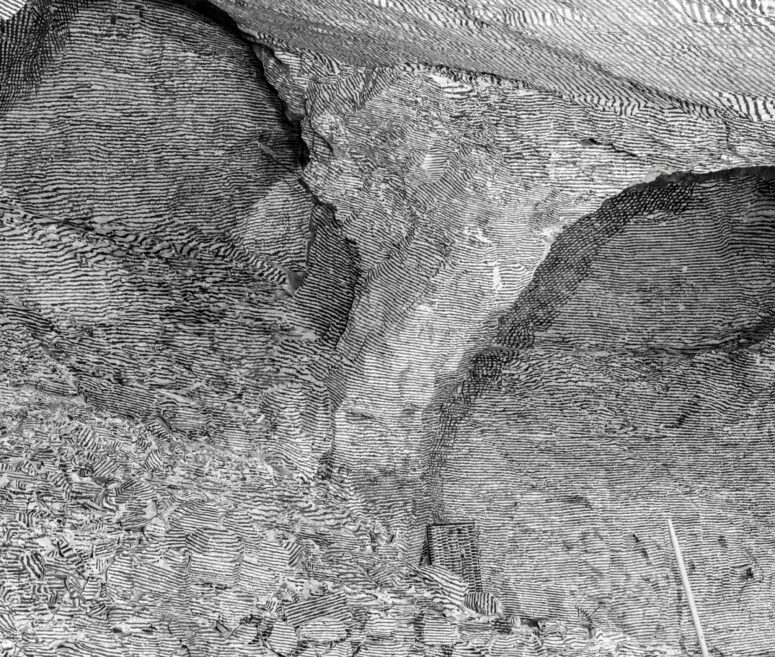
MICHAEL JAKOB
In your work there is always the sense that mountains are an idea, that they are actually cultural constructions. They are not just geographical and geological realities; they have rather been “built” by different generations layer after layer.
JULIUS VON BISMARCK
Mountains are profoundly visual. The parts of the mountain that we can’t reach—which are often the majority—are essentially useless to us in practical terms. We don’t inhabit them, we don’t use them; they exist mostly as images, as a visual background.
I don’t really know when the idea emerged that visuality, or images, became more important—perhaps it began when we first gained the ability to mass-produce them. And that’s actually what my work Landscape Painting (Mine), conceived for the former mine in Dossena, also touches upon: what changed in the world, and in our relationship to the world, once images could be reproduced on a massive scale. Of course, we’ve always been able to create images—think of cave paintings—but those didn’t have a major impact on humanity as a whole. The real transformation happened when images became reproducible, when they started to circulate widely and shape our collective perception.
I’m interested in how our worldview changed with the invention of the printing press, with etching—and, in this case, with painting. When people went to church, for example, they might see a painting of a landscape within a religious context, perhaps depicting a place they had never seen or even heard of. That’s what fascinates me: the idea that humans could form a visual imagination of a landscape they hadn’t directly experienced. I think that was the beginning of a globalized sense of vision—something that developed in Europe and profoundly shaped how we see the world.
This shift also has a major colonial dimension. It was through etchings and printed landscape images that Europeans formed their visual understanding of the so-called colonial world. We perceived other territories—those we were exploiting through colonial power—only through these printed, black-and-white images.
That’s partly why I chose the setting of the caves and the mining landscape. The work belongs to a series I call Landscape Paintings—though, in this particular case, “painting” isn’t the most accurate term. It would be more precise to call it landscape etching, landscape drawing, or landscape print.
MICHAEL JAKOB
I consulted some of your catalogues and among the many things that interested me was the peculiar relationship in your work between the digital; the scientific, even ultra-scientific data; and, on the other hand—something I would call elemental in the pre-Socratic sense—a perspective that reminds us of being part of the Earth as a living system. Two extremes that come together and overlap in your works.
JULIUS VON BISMARCK
Yes, that is how it often appears. There are perhaps two poles in my work that, for me, naturally belong together, yet from an external perspective seem very far apart. And indeed, they are far apart. It is the difference between a rigorous, natural science–based approach to the world and everything that cannot be described through such an approach. This duality also reflects what I went through in the course of becoming an artist. In the beginning, I came from a family with a scientific background: my father is a geologist, my brother a physicist. I grew up in an environment in which culture was respected—my mother studied art history and architecture—yet I nevertheless believed that the world was fundamentally and entirely describable by natural science. For me, that was a given. Only later did I realize that this view is far removed from what I now believe reality to be.
This shift accelerated when I worked at CERN as an artist-in-residence. The deeper I delved into physics, trying to understand the latest world models, the more interested I became in the philosophical dimensions—in what I call the “construction of reality” in a place like CERN. One cannot grasp this without also engaging deeply with physics, without attempting to understand what it actually is.
At first, physicists provide only a very simplified, highly compromised account of their work, because they assume—correctly to some extent—that one cannot easily comprehend the complexity of what they do. So one must move past that linguistic or cognitive barrier, and then the two sides come closer together. I spent a great deal of time on this and eventually reached a point where I began to understand more and more of the blank spaces—those aspects not describable by what we call natural science or physics. Even mathematics has many blind spots. This led me to ask: What do we do with everything that remains unexplained? This question opens up a wide range of perspectives: Should one adopt a religious framework? It creates space for many possibilities.
MICHAEL JAKOB
It reminds me very much of Goethe. He, too, embodied these two realms. He considered himself to be more a scientist than a writer or a poet. Goethe believed that his scientific contributions would be more important than his literary or artistic ones. During his entire life he cultivated both parts, both cultures.
JULIUS VON BISMARCK
Sadly, today it is nearly impossible to be that kind of figure, because science has advanced so far. It would require an entire lifetime simply to understand what is happening at CERN. And it also takes a whole lifetime to be a philosopher. And a whole lifetime to be an artist. It is extremely difficult to do all of this at once. Even if one had the intellectual capacity, there is simply not enough time.
MICHAEL JAKOB
Can a meaningful dialogue exist today between artists—between you—and scientists working in an extremely abstract sphere where everything is explained, when possible, by mathematical formulas?
JULIUS VON BISMARCK
Yes, there is dialogue. In fact, I formed a close friendship with one physicist during this period. Our discussions range widely, especially toward cosmology. Much of it is highly speculative. In such speculative terrain, the collaboration between an artistic mind and a theoretical physicist or cosmologist can be extraordinarily productive.
In some areas, 99 percent is an established fact and only a single percent requires a small theoretical adjustment. But in other areas, only 1 percent is known and 99 percent remains unknown. In those domains, creative processes—such as those used in art—make far more sense. One can say, “Let us imagine this is reality,” and then attempt to find a mathematical solution for such a scenario, or investigate what physical principles might lead to it. This applies when thinking about the future, or about entirely unknown or “dark” fields of physics, or about phenomena for which we simply lack data.
This is the edge of science. Science must follow rules, but if there is no information, there are no rules to follow. One can propose almost any theory, because it is difficult to disprove a theory when there is no information available to contradict it.
MICHAEL JAKOB
What do you think of Charles Jencks’s Garden of Cosmic Speculation? He was a philosopher and architect who, together with his wife, Maggie Keswick, transformed a large estate into a complex park designed to convey some of the most abstract concepts of modern physics thanks to certain simple artifacts. There is a black-hole sculpture, the sculpture of the DNA structure, a bridge conceived following the Fibonacci sequence—tangible objects that attempt to convey physical presence to ideas normally understood only by specialists. What he attempted was extraordinarily daring: to pick up the most abstract concepts of contemporary science and translate them into art, all of these by creating a hybrid landscape park.
JULIUS VON BISMARCK
That sounds remarkable. At CERN, where they commissioned a work from me, I encountered a similar challenge. I am interested in making artworks that do not illustrate what we already know but instead gesture toward what we do not know. Of course, you cannot depict the unknown directly, but you can create an experience that makes the viewer more aware of the limits of human imagination. People often assume that imagination is boundless. But it is not.
MICHAEL JAKOB
Kant made it clear that we perceive the world only through human eyes—we do not possess the eyes of animals or of God (the one who would be able to see at once from all the possible points of view). Our vision is relative and incomplete.
JULIUS VON BISMARCK
Precisely—and it is not only about the eyes. This already shows that we are visual beings. It also connects to the exhibition I recently presented in China, where I showed hollowed boulders. A boulder is like a small fragment—a Lego piece—of an entire mountain. In China, I found a factory highly skilled in stonework, and the challenge was to remove 99 percent of each boulder from the inside while leaving the exterior intact. We opened a hole at the back and emptied the interior, first using CNC machines and then by hand, thinning the crust to less than a centimeter. Seen from the front, it appears to be a complete boulder: every detail of the surface, the crystals, the dirt—everything is present. Yet, in fact, what remains is only 1 percent of the original mass.
MICHAEL JAKOB
It becomes something like a relief or a model. This is interesting if we take into consideration the Chinese tradition. If I am right, in China there is a very particular way of conceiving nature, and especially mountains. In Chinese mythology, there are Five Sacred Mountains, the most important of which is Mount Taishan. Unlike Westerners, the Chinese traditionally believe(d) that by creating a copy of these mountains—for example, in a seventeenth-century garden—and even if you went further by producing a copy of that copy (a representation that might look awkward and even kitsch, let’s say a plastic model of the Five Sacred Mountains in a restaurant), the very same forces that reside in the original would reside also in the copy. The copy is not considered to be a representation, but instead something that has the same energies as the real thing, the geographically known mountains.
JULIUS VON BISMARCK
That makes sense. It is similar to the cross in Christian contexts: it need not be the “original” cross for it to hold meaning. The form alone is enough for it to represent something that must be respected, like a flag. I find this significant, because it returns to the point I am making about the mountain and what lies inside it. What is inside a mountain does not have to be geological; it can be human-made or imagined.
MICHAEL JAKOB
During the Renaissance, when they began building artificial mountains back in the fifteenth century—I think of Ferrara with the Montagnola di San Giorgio and many other places—seen from the outside these structures were unmistakably mountains or hills. Inside, however, they contained grottos. In a sense, these double-faced objects were already showing what you are doing now. At Pratolino, for example, there is the famous Apennino, the personified statue of the mountains, with a grotto inside of it. There is the outer form, the “positive” or full side, if you will, and the inner form, the void. The coexistence of the two is quite fascinating.
JULIUS VON BISMARCK
Yes, and what lies inside can indeed be a cave that has always existed, but it can also be something completely different. Yet from the outside it still appears to be a mountain. That was also the case with my recent exhibition at the Beizhou Museum in Nanjing. The museum itself is a mountain—or rather, it is built as a mountain—but it is a hollow mountain. This was particularly interesting for me because I created this exhibition immediately after working in the cave—or more precisely the mine—in Italy. The museum originated as a bunker roughly seventy years ago, during one of the Chinese wars. A hill in the city was extended with a bunker structure, so from the outside it simply appears to be part of the hill, but once you enter, it is completely hollow. You encounter the mountain’s surface as a conceptual envelope, so to speak. You are inside a hollow mountain within an urban environment. That is where I exhibited the hollowed-out rocks. So the viewer is looking at a hollow rock while simultaneously standing inside a hollow rock.
MICHAEL JAKOB
Our Alps are also quite hollow; they contain uncountable caves, caverns, military structures—an astonishing amount of infrastructure. Seen from outside, the Alps appear extremely solid, yet inside they are full of cavities—streets, tunnels, an entire system carved into the mountain.
JULIUS VON BISMARCK
This hollowness is also a symbol of power. I find it interesting to regard mountains as entities of power, whether in terms of military defense or otherwise. Mountains remain the most effective protection against an atomic explosion. Spending extended time in the Alps, one eventually understands that their defensive potential has always been one of their defining aspects. Throughout the history of warfare, mountains have functioned as the best possible defense—more effective than any artificial structure.
This produces a culture in mountainous regions that is completely different from the culture of the flatlands. In the flat parts of Germany, for instance, there is no natural defense, no escape. Armies on horseback could simply sweep across them; tanks can drive straight through. There is no shelter. An atomic bomb would cause far greater devastation there because the blast can travel unimpeded across large areas. In the mountains it is different.
Developing a high culture in a mountainous region—and subsequently hollowing out the mountains—makes considerable sense not only in military terms but also in relation to the exercise of power. Throughout the Alps, for example, one finds numerous caves and tunnels constructed for strategic military purposes, but also to serve as infrastructures of energy production and storage. And some valleys are now completely perforated—full of tunnels and cavities extending in multiple directions—designed either for energy storage or for generating electricity. It is a very contemporary use of mountains.
MICHAEL JAKOB
Hydroelectricity has completely changed the way we see the Alps. It emerged in the nineteenth century, twenty years after the regulation of the rivers. First, in the 1860s and 1870s, the water courses were regulated, then, after 1890, hydroelectric development began, and everything changed. It is quite fascinating when you look at it: most of the waterfalls actually disappeared in order to let the electrical system work. Today we can only dream of the impact of the waterfalls of the past.
JULIUS VON BISMARCK
Yes, or even the artificial ones, because they receive exactly the amount of water that the hydroelectric companies need. But it is also a major problem. With the artificial lakes, the water level is constantly changing, which effectively destroys their ability to sustain life. There is some life in them, but it is not comparable to a natural lake. Most life in a lake depends on the stability of the shoreline, and because the shore is always shifting, nearly everything is wiped out. The system essentially serves as storage. The lakes are not needed to produce power as such; they exist to guarantee that power is continuously available. During periods with little rainfall, you draw down what was previously stored, so the water level is always fluctuating. If someone were able to invent a system that resolved this issue, we could have biodiverse lakes instead of these dead reservoirs—such as the very large one at the Verzasca Dam. A few years ago, when it was temporarily emptied, I hiked across the exposed lake bed. It was a unique opportunity. They have to empty it roughly every fifty years to clean and repair the lower parts of the dam that are inaccessible when it is full. The lake bed becomes a desert—completely barren. I examined all the structures they had built there. It is remarkable. Many of the original trees are still standing at the bottom, because at the time wood was not particularly valuable, so they simply left them and flooded the area. The scene resembles what it would look like if, from one day to the next, the Alps became a desert: the trees would remain upright, but everything in between would be nothing but sand and rock. That is essentially what the lake bed looks like.
MICHAEL JAKOB
In order to build these enormous dams, vast amounts of forest had to be destroyed. Jean-Luc Godard’s very first film, Opération béton (1958), tells the story of this massive transformation. It focuses on the construction of the Grande Dixence, still one of the largest and highest dams in the world, located in the canton of Valais, in Switzerland. The dam was under construction for fifteen years. Godard’s film, which is somewhat propagandistic, celebrates “the power of power”—the power of electricity—and the idea of building national electrical independence. Yet to achieve this, enormous forested areas had to be erased. Your work Bäume ohne Grenzen (Trees Without Borders), in Safiental, reminded me of this.
JULIUS VON BISMARCK
Yes—well above the tree line. The Safiental, too, is completely hollowed out. It contains several aboveground and underground reservoirs, as well as a tunnel used for generating hydropower. But the situation is also about how the landscape itself is changing. All hydroelectric systems create intentional transformations meant to prevent other, potentially more harmful changes. Personally, I sometimes prefer the presence of a dam and clean energy to the alternative of “dirty” energy that causes problems elsewhere. One such problem is temperature rise, which is also elevating the tree line—already significantly higher than it once was in the Swiss Alps.
But the tree line remains partly an imagined boundary, because the forest we see today has grown slowly over thousands of years. For a mature forest to develop, it generally requires between 500 and 1,000 years. It is not simply a matter of how quickly a single tree grows; an entire forest system is needed—one capable of breaking the wind and creating sheltered conditions in which younger trees can take root. It is a whole ecosystem. These conditions could in fact exist at much higher altitudes by now, but the trees are not migrating upslope fast enough, even though temperatures at elevations 400 meters above the current tree line—roughly at 2,000 meters—would already permit growth. I planted the tree at 2,400 meters. According to the local forester—the ranger—my initial idea of planting 200 meters above the current line was too conservative. He said, let’s go 400 meters higher. In his experience, temperatures have changed so dramatically during his time working there that he sees no difficulty in growing a tree at that elevation. What matters is not the severity of the winter, but the length of the summer. If an area has more than four months with temperatures above 4 degrees Celsius, trees can grow. This condition has already changed across many regions of the Swiss Alps.
MICHAEL JAKOB
Martino Pedrozzi, who teaches architecture at the Academy of Architecture in Mendrisio, has produced very interesting projects concerning the forest line. He is an architect deeply attuned to the surrounding landscape and began working with the ruins of former agricultural buildings (baite in Italian) in the Alps, stone structures that once housed cattle during the summer months and that now lie mostly in ruins. His interventions saved some of these ruins while others were deconstructed in a provocative and surprising way.
JULIUS VON BISMARCK
That sounds extremely interesting. The tree line is one of the most beautiful zones in the Alps. One of the remarkable aspects of mountains is that they offer so many different climate zones within such a small geographic area. Within three hours of walking, you can move from a typical European forest into a high Alpine forest where every tree resembles a bonsai, simply because it can grow for only a very short period each year. That limitation opens space for many other species.
MICHAEL JAKOB
The ecological and atmospheric diversity typical for mountainous regions was already recognized in the sixteenth century. Conrad Gessner, a professor of Greek literature and philosophy, a physician, and a botanist, among other roles, was one of the first to observe it. In 1541, he wrote an important letter on the admiration of mountains, included as the introduction to a book on cheese production in the Alps (De lactibus).
Let me come back to something that came to mind when looking more carefully at your work: the importance of the antique theory of four elements. Some of your projects relate clearly to fire—various forms of combustion or explosions—while others engage with water or air. As we know, the theory of the four elements shaped European thought for nearly two millennia and also had a significant influence on medical science and the doctrine of four temperaments or characters. Hartmut Böhme has written extensively on this. I was particularly struck by your performance in which the top of a mountain explodes. It immediately reminded me of one of my favorite sequences in the history of cinema: the ending of Zabriskie Point (1970). However, in the middle of the nineteenth century, our proto-ecologist Thoreau accidentally set fire to the forest near Walden Pond. The very person who insisted on treating nature with reverence ended up burning what, to him, seemed almost something sacred.
JULIUS VON BISMARCK
In my work I try to understand the invention or reinvention of nature, as we discussed earlier. Fire plays an important role because it is both destructive and almost alive—it consumes, spreads, and behaves in ways that challenge our concept of life. Yet it is fundamentally part of life. Fire has always been a component of the self-regulating planetary system—what one might call Gaia, or simply nature. If atmospheric oxygen levels rise too high—today we are in a high-carbon era, but imagine a high-oxygen era—combustion becomes dramatically more likely. Even a 3 percent increase in atmospheric oxygen leads to far more wildfires. Historically, when oxygen levels rose, extensive flora burned. Those fires then reduced plant life, which in turn lowered oxygen production. It is a self-regulating system. At a larger scale, fire is an integral part of this regulation. The only reason life exists is that these systems operate together in ways that seem pretty magical. It is easy to become religious in the face of such precision. The atmosphere maintains roughly 27 percent oxygen, seemingly just the right amount—not too much, not too little—for life as we know it. The same applies to rocks and volcanic systems, storms and weather patterns—each one part of these interlocking regulatory mechanisms.
My research concerns the contemporary meanings of these forces: storms, fire, and eventually, I hope, earthquakes and canals as well, which are also part of the system. The overarching question is how this all works: How is this actually working? What forces maintain such precise conditions that are capable of hosting us on this planet? A slight deviation and complex life would not be possible—perhaps only bacteria; a greater deviation, and no life could exist at all.
MICHAEL JAKOB
This question preoccupied many of the first modern philosophers. Until the seventeenth century, nature in general was typically interpreted as bad or even diabolical. It was associated with chaos, ugliness, and horror because of the original sin, Paradise Lost, and the Great Deluge. The “real” world was considered to be the invisible one, something already stressed by Plato when celebrating the immaterial realm as the only one valid.
Probably the first scholars to consider nature in the way you describe it were the so-called physico-theologians of the seventeenth century. They worked alongside Newton, who had dismantled the old cosmological explanations of nature and the world but felt guilty for having done so. By demonstrating that everything could be explained by physics (or mathematics), Newton destroyed the traditional idea of a harmonious, enclosed, and complete cosmos. Yet he was himself deeply religious, and for the next twenty years he worked to “save” religion. He felt that he and his colleagues had inadvertently undermined it by adopting a scientific worldview, and he wanted to prove that the world—even if it appears chaotic to our eyes—nevertheless possesses some form of order and meaning.
There emerged, for example, even a sub-theory called “hydrotheology” at this time. When in the seventeenth century people asked, “Why do we have so many seas and oceans?” the prevailing answer was still that they must be remnants of the forty days of the biblical Flood—a divine punishment—hence water was considered inherently negative. Once scholars began to study nature in situ, and especially the Alpine regions, they started to understand what we call the hydrological cycle. An influential German poet from Hamburg, Barthold Heinrich Brockes, published a book of poems titled Irdisches Vergnügen in Gott. Poets, scientists, and philosophers alike attempted to find arguments showing that, although mountains may appear chaotic and life on Earth may seem disorderly, if one looks closely—precisely as you said—the details and the systems reveal an astonishing coherence. This idea has returned in recent decades, especially in the writings of James Lovelock and Bruno Latour.
JULIUS VON BISMARCK
And this leads back to cosmology, which is how we began this conversation. If you look at the number of stars visible in the sky, you encounter a scale so vast that it exceeds our cognitive ability to comprehend numbers. It is simply too large. Within the observable universe alone—which is only a fraction of the actual universe, whose total size we do not know—there are an unimaginably large number of stars, and therefore many more planets. Perhaps the probability that a planetary system would function as harmoniously as ours—so perfectly balanced that it can support life—is essentially zero. But if the number of planets is large enough, even an almost impossible scenario will occur at least once. So maybe there was no divine creator designing this system; maybe it is not “likely” at all. Perhaps, somewhere in the universe, simply because there are so many planets, one of them happened to develop this extraordinary, life-supporting equilibrium. It is almost impossible to imagine, because the numbers involved are beyond us. And the explanation is not at all satisfying.
MICHAEL JAKOB
You know the Eameses’ film Powers of Ten (1977)—about scale and its limits. I often show it to my students, and I like to pair it with George Kubler’s “The Shape of Time” (1962), a wonderful essay on temporality, the essence of art, and other topics. Kubler states that when we look at the stars and, of course, assume they exist, we are mistaken—the light we see has taken such a long time to reach us that the respective stars actually no longer exist. They were stars, but they are stars no more. We are looking at objects that have already disappeared because of the immense distances—billions of light-years—between us and them.
JULIUS VON BISMARCK
And this extends so far that we can actually look back into the early stages of the universe. The farther we look, the less we see stars at all—we see only the primordial “soup” from which stars eventually formed.