
VALENTINA GERVASONI
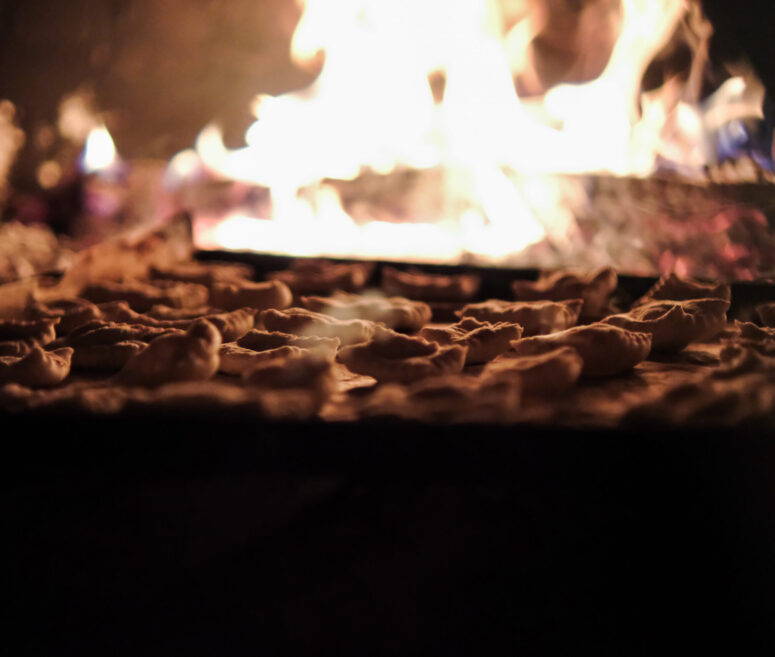
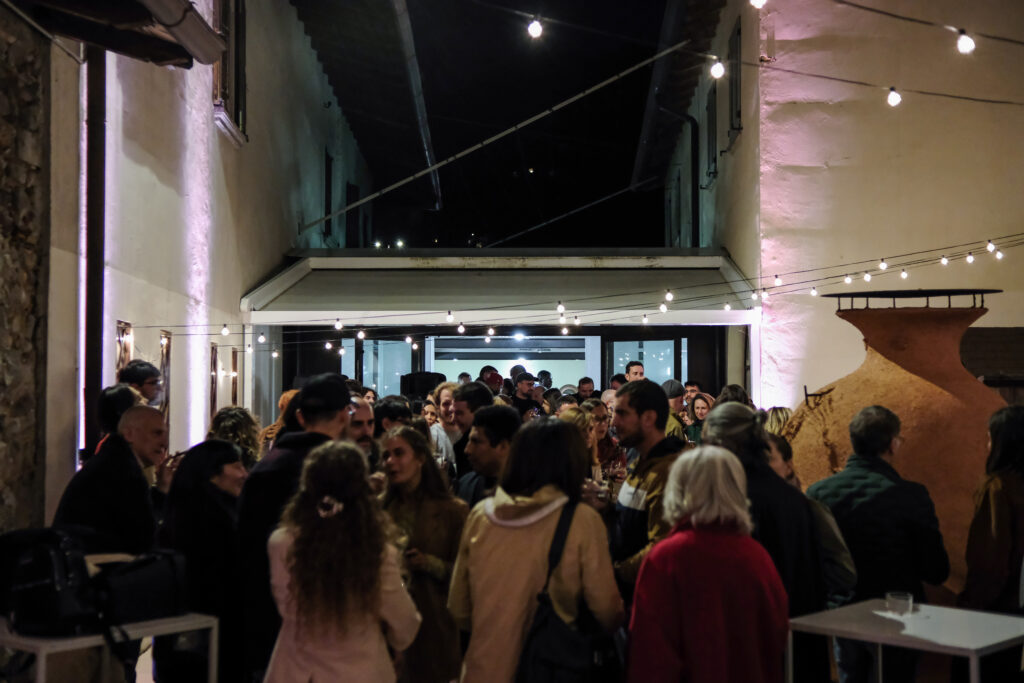
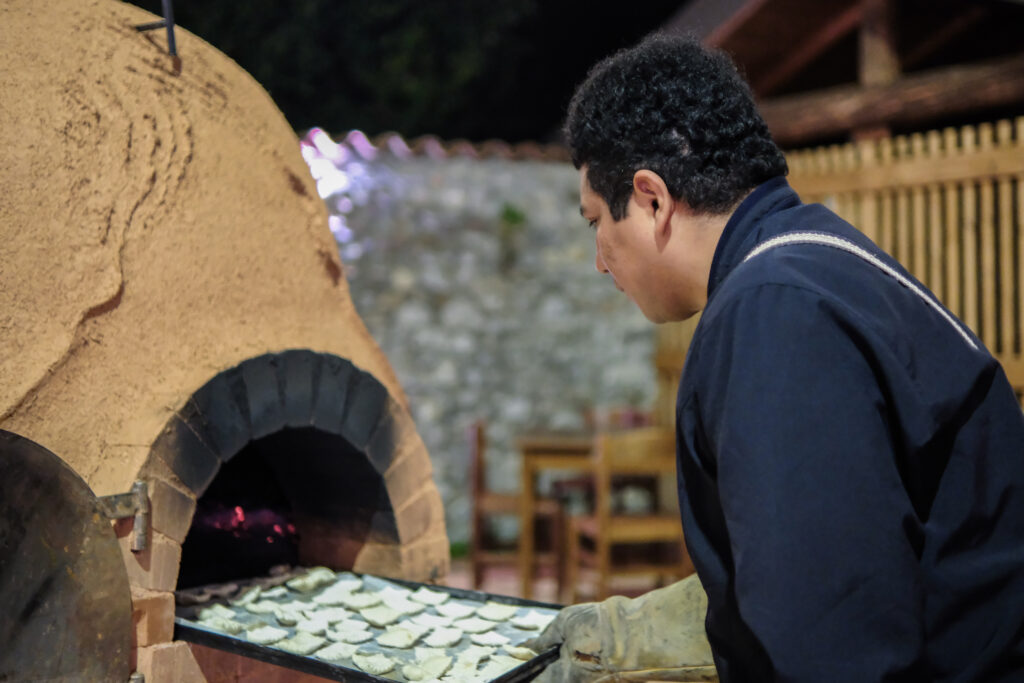
When we thought of your invitation for Thinking Like a Mountain, we wanted to connect the Indigenous traditions linked to bread in Tucumán, Argentina, with those from Val Seriana in Bergamo, Italy, linked to pasta. The result was an oven-artwork activated during a Bread Baking Party, where people baked the Michini di San Patrizio, a “miracle bread” once eaten in Vertova in case of illness in people or animals. Your work has the power to celebrate and update customs that are sometimes forgotten, creating opportunities for the local community. What did it mean for you to create this work in a village in the province of Bergamo? How did the local context influence your reflection on tradition, memory, and community?
GABRIEL CHAILE
In San Miguel de Tucumán, where I was born, we don’t know we are Indigenous, we think of ourselves as white—perhaps because of the country’s idiosyncrasy and the way public education addresses Indigenous culture and population. It is different in the mountains, where Indigenous communities still live and resist against all odds—there, the awareness of being Indigenous is alive. But I grew up in the outskirts of a large and growing city where, in order to adapt, most of us thought of ourselves as white. We are poor, fake white people who don’t know where we come from, and we bake homemade bread to survive and feel like we belong to something. My work was born there, by looking at myself and at that context, far from the mountain and from possible dialects that have surely survived through time. Coming to the Italian hinterland and discovering a village that speaks another language and responds to other customs made me reflect on how knowledge is preserved in small places. I don’t want to call it tradition, because I believe it is much more than that; it is vital knowledge that dialogues across time and has no written form—it manifests in objects, in flavors, in ways of relating. For me, Vertova was this. I asked myself what it means to be Indigenous.
VALENTINA GERVASONI
Many iconographic elements in your work derive from La Candelaria culture of the pre-Hispanic groups of Tucumán, whose ceramics often feature complex geometric decorative motifs alongside animal taxonomies, specimens of unknown fauna, anthropomorphic or hybrid figures combining human and animal traits or traits from different animal species. These come together to create and transform relations between all social agents (human and non-human groups), beyond the long-standing Western distinction between nature and culture. What inspires the ovens you imagine, and how they come to life in your imagery? Are there specific ancestral traditions, rituals, or practices that you reference that shape your research?
GABRIEL CHAILE
I started out feeling a strong fascination for these archaeological ceramics from the Candelaria culture. I like their roundness, their sense of humor, their synthesis, the freshness of feeling the imprint of the one who made them, the one who worked that vessel. It was love at first sight. But all that we call ancestral I never actually saw—it was pointed out by others when looking at my work. I can tell you what I saw and felt: I saw poor people with a similar skin color, working in the same way to feed their children, creating popular economies and supporting each other to solve their problems in the city. Many used bread ovens to cook and thus solve their economic problems; many did it remembering their mother, father, or grandparents who had taught them. My family was one among many distributing warm bread in middle- and upper-class neighborhoods. I always saw the contrast of the city and wondered what made the difference. That’s how I realized there was knowledge there, unwritten knowledge that helped people resist. What I saw, the experts called ancestral…and it probably is.
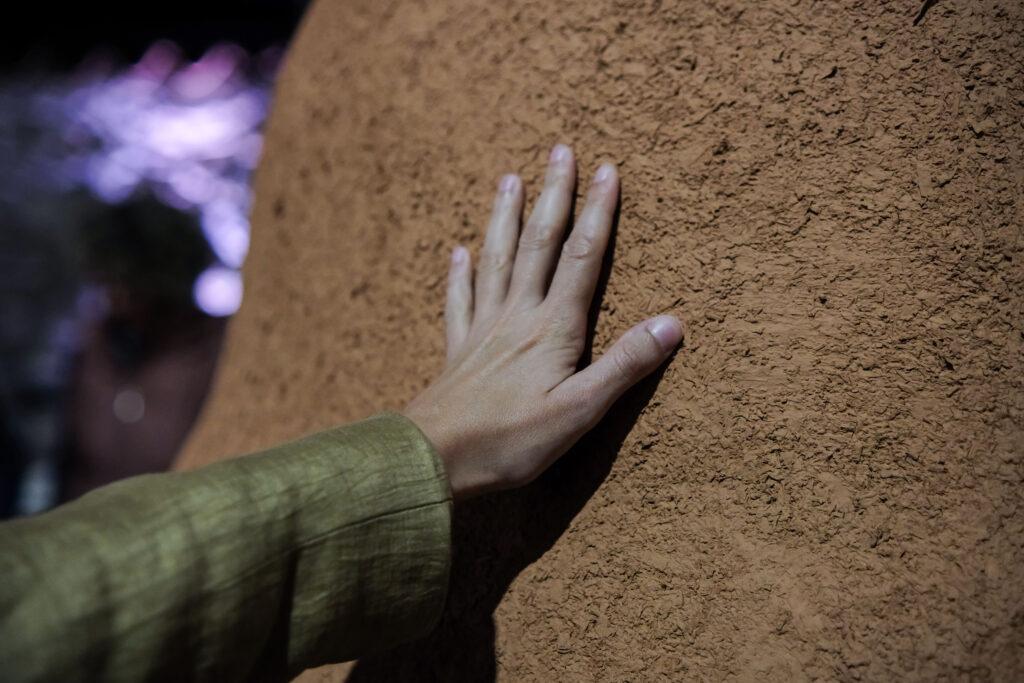
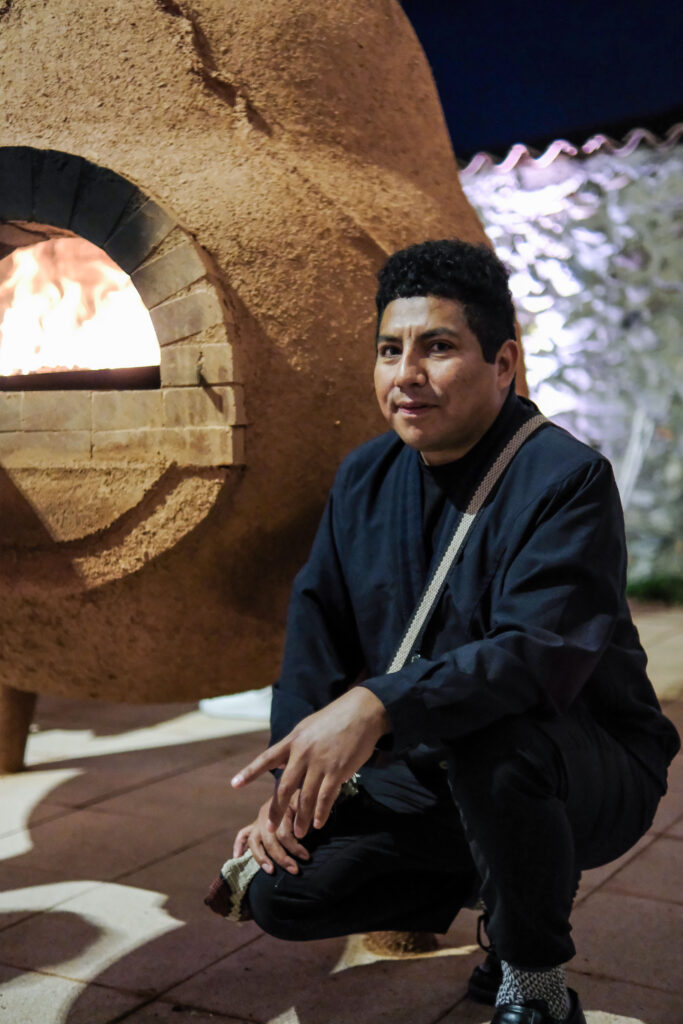
Furthermore, the use of adobe to construct many of my anthropomorphic clay ovens is influenced by the religious education I received and its idea of the “miraculous.” I demand much more from materials than they can offer. My work is also related to the resistance and Peronist history of my family, their struggle, the magical aspect of the miraculous and the environment of poverty. That is why I return to the primitive forms of Indigenous morphology.
VALENTINA GERVASONI
The historical-cultural anthropologist Christoph Wulf describes anthropopoiesis—the process by which human beings become such, forming their identity—as not exclusively individual but rather intrinsically social, historical, and cultural. One becomes human through shared social practices, rituals, linguistic acts, mimetic and performative processes, and through the use of objects rooted in culture that serve as vehicles of intergenerational transmission. In his studies on imagery and ritual practices, Wulf explores the active role of images in understanding the world and, above all, in shaping ourselves and our communities, in forming and transmitting cultural identity. What symbolic importance does the oven hold within a pueblo? You have created several ovens in very different contexts; have you noticed any differences or peculiarities?
GABRIEL CHAILE
I believe the oven has the particularity of bringing people together and cooking for many, regardless of the social class of the communities where my works are activated. I think that in poorer contexts I sensed a greater familiarity with the piece, like the love at first sight that I felt for the Candelaria ceramics. In non-poor communities, I noticed more curiosity and more questions, provoked by the strangeness of the material and the form.
VALENTINA GERVASONI
Much is said about the urgency of overcoming a Eurocentric vision of art history and of looking at artistic practices from trans-local and transnational perspectives. Your works, in some way, return visibility to minority subjectivities that often remain on the margins of the hegemonic narrative, addressing issues such as class, ethnic belonging, spirituality, and gender. Do you think this dialogue between formal concerns—drawn from family and popular memory as well as broader artistic codes—can contribute to questioning a canonical (Western) idea of art history?
GABRIEL CHAILE
I think so, or at least it puts the topic on the table for discussion. I believe the way to initiate dialogue is to stop being “non-hegemonic,” to stop being a Latin American artist and simply become an artist of this medium.
VALENTINA GERVASONI
The works you create are objects that are meant to not only be observed, but also to be lived and participated in through a process you define as “genealogy of form.” What do you mean by this expression?
GABRIEL CHAILE
I recently read an article about my work that defined genealogy of form better than I could, and it said: “genealogy of form” is the idea that visual motifs repeat themselves throughout history, acquiring new meaning each time they reappear.
VALENTINA GERVASONI
Who are the thinkers and intellectuals that inspire your work?
GABRIEL CHAILE
First and foremost, my friends, whom I observe carefully and from whom I learn a lot; then the people I meet during my travels, and those who live in extreme situations and share with me their stories and images. I am inspired by the reflections I hear, which help shape my way of thinking. There is something in peripheral thought and in stories that I am very interested in watching and listening to. These observations resemble the conclusions of intellectuals I later encounter in books. Likewise, during my travels I come across marginal writers I read, as well as Michel Foucault and biblical texts.
VALENTINA GERVASONI
In your work, there seems to emerge a polyphony of voices—not only human but also animal, natural, and linked to collective memories. If we think of works as collective bodies, what kind of imaginary or real community interests you?
GABRIEL CHAILE
I imagine a more interconnected community, more attentive to its different parts, without so much difference between being and having to be.
VALENTINA GERVASONI
Many of your works speak of transformation: of matter, of landscapes, of memories. If you had to describe your research as a rite of passage, what kind of transition would you like to evoke or make possible?
GABRIEL CHAILE
This part is a mystery even to me, although I would like it to be like music that invades your body, that pushes you to move, to feel multiple sensations, to awaken memories and travel through time.
VALENTINA GERVASONI
What does experiencing a true sense of belonging to a place mean to you?
GABRIEL CHAILE
If place means abandoning the belief that you belong to a place because people or other beings leave a mark on you. For me, the mere fact that these people or beings are situated in the same place—for example, Tucumán—makes me feel Tucumano.
Credits: Foto Paolo Biava