
IRENE GUANDALINI
Alessandra, you have long focused on the theatrical dimension of public celebrations in your research. We’re talking about civil and religious ceremonies that are often an expression of hegemonic power, be it temporal or spiritual, involving an officiant on one side and an audience on the other. What is the function of such rituals and how do they affect the community?
ALESSANDRA MIGNATTI
We mustn’t blur the more general theme of the festival with that of the ritual. The festival, within which a number of rituals might take place, brings about a genuine suspension of everyday life, triggering a new time and a situation midway between reality and dream. It requires a whole series of preparations: the space itself is transformed, people dress differently, there is food and drink, music and scents are prepared. The festival, in fact, plays on many codes of expression and sets off a whole series of perceptions, acting synesthetically on the participants to leverage their emotions. Thanks to this new reality, the archetypes of a community emerge, as does the sacred, that set of elements that form the very foundation of the community itself. In this way, society is regenerated.
Over the centuries, celebrations have been used to represent and assert authority, which in this way has renewed the essential foundations of its being, but this does not mean that the time of celebration was necessarily used to exercise hegemonic power. All societies have festivals, which have been necessary since humans began living together and sought to overcome difficult times through rituals—for example, to overcome the fear of death or deal with conflicts. Festive moments serve to strengthen the community. During the festival, an alternative space is created and everything becomes highly symbolic. We know symbols have the power to speak directly to our unconscious and act deeply on people’s souls. Language also changes; it is no longer just everyday language that is used, but a series of words and expressions with a high symbolic value.
I recently saw a video about a game created by two little brothers during the lockdown due to the COVID-19 pandemic in Ponte Nossa, a small village in the Bergamo area famous for the ancient tradition of the Festa del Màs. This is a spring ritual that celebrates fertility and the rebirth of nature, which takes place in various moments over a period of roughly a month: first, the “sacrifice” of a large fir tree that is chopped down with an axe before being transported to Ponte Nossa, where it is welcomed by a festive procession and all the authorities and the sound of the band; after crossing the village, it’s placed in the parish churchyard and, after mass, it’s blessed and entrusted once again to the members of the Màs, who must prepare it for the next stage of its journey. On May 1, the tree is carried by hand and with the help of ropes to the top of Monte Pés—a test of strength that the community doesn’t shy away from but rather takes pride in. The tree remains at the top until the evening of June 1, when it is cut down and burnt, surrounded by the celebrating community. The two little brothers missed the festival at such a critical time when public celebrations were not allowed, so they recreated it, with all the characters and various stages, using Legos. There were the two different moments of transporting the tree , the priest’s blessing, the bonfire, and the convivial part with the banquet where everyone eats and drinks together. As mentioned earlier, all the senses are stimulated at a festival, all forms of perception are activated. I found the video extraordinary because, at a time of great difficulty for the community, the two children felt the need to create a community within their own four walls, retracing the essential and most significant features of the festival through play. The video also features voices, the strenuous climb, and the music of the band. Human beings need celebrations, those magical moments when archetypes and the sacred resurface, moments when the community is strengthened.
IRENE GUANDALINI
Even today, Dossena, the village in Val Brembana where Adele and Roberto’s project is located, is particularly lively in terms of festivals, traditions, and collective participation in public life. However, this heritage is at risk of disappearing due to the depopulation affecting the village. How did you approach Dossena and how did you engage primarily with the cultural history of the village?
ROBERTO CASTI
We spent a month living in Dossena with Adele, and right from the start, two aspects emerged that the town is deeply attached to: celebrations—particularly masquerades—and the presence of the mine. We were especially interested in the community’s relationship with its mining past and how the theme of work was perceived in relation to it, reflecting on the connection with the surrounding mountain environment and wondering whether today the link with the mine could be transformed into an ecological relationship. As for the masquerades, this is a theme that the people of Dossena still feel very proud of, as they are a living part of a cultural heritage that has left a deep mark on the collective memory. Although they are no longer organized today, the masquerades remain rooted in people’s memories and lives.
ADELE DIPASQUALE
The day we arrived in Dossena, we were welcomed with a party, a festival in a district below the village where people gathered, ate, sang, and played folksongs that everyone there knew. This was our first impression. We met some people who were playing the accordion and then, through our interviews, discovered that they were also part of the group of former miners. It was also very interesting for us to meet different generations, from the very young members of the public administration to the older ones. The latter have a different relationship with work—often having developed a traumatic association with the mine—but they are also the custodians of a rural memory linked to a subsistence economy, in a relationship with the geography of the territory (and once again, with work) that has changed greatly over recent years. Seeing how different temporalities converge in the same territory, we asked ourselves not only what this country’s relationship with its past is, but also what its future looks like in a neo-capitalist global economy, where a series of dynamics linked to rituality, community, and the way of conceiving work are undergoing rapid change. In Dossena, these plans overlap and questions arise, for example, about the significance of continuing the tradition of masquerades. Some residents told us about the conflict that existed in the past between the people who performed with masks—the more conservative wing, so to speak, that wanted to keep the tradition intact and the dynamics as they had always been—and another side that wanted to turn the masquerade into something different, maintaining that such a transformation would not distort the true content of the masquerade.
IRENE GUANDALINI
In fact, Val Seriana and the Orobie Alps area in general are particularly interesting places to observe how an archetypal way of seeing or feeling, so to speak, has become rooted in the historical and social fabric and evolved over time.
Alessandra has long studied the Bergamo area from a historical perspective, seeking to better understand why it was considered a liminal territory, representing the wild and the uncultivated. In the sixteenth century, Bergamo and its forests were viewed in contrast to one of the cities that represented orderly and rational civilization par excellence: Venice. This is a dichotomy that has long shaped the Western notion of nature, where the unknown and that which is not directly under human control is intriguing yet at the same time frightening.
It is also interesting to see how, over time, the people of Bergamo were forced to leave their homes due to poverty, hunger, and destitution, migrating to richer areas such as Genoa or the aforementioned Venice, where they performed thankless tasks, sometimes doing menial jobs such as porters, or sometimes those associated with the taboos of death, working as gravediggers. It is striking to see how some migratory dynamics are incredibly similar to those currently seen globally—without going too far afield, suffice to consider the Mediterranean, for example.
Can you tell us more about both the origins of Bergamo as a threshold between the cultivated and the uncultivated, and the reputation of the Bergamaschi as migrants, identifying the cultural heritage that is still present today?
ALESSANDRA MIGNATTI
Bergamo’s history includes illustrious architects, mercenary captains, soldiers, and musicians, but despite these famous names, the city’s fame is linked to something “different”: masks. In particular, the mask of the servant. In the past, I have dealt with this otherness of Bergamo through the figure of Zanni, a mask that appears in the commedia dell’arte that takes various names and changes clothes—becoming Arlecchino (Harlequin), Brighella, Scarpino or Truffaldino—depending on who impersonates him and where he is performed.
In the commedia dell’arte, which was extremely popular and well-known throughout Europe, Zanni speaks Bergamasque; however, I wouldn’t say that he is a Bergamasque mask, as we find his name across many regions of Italy and Europe. Some say that his name derives from the Sanniones, the mimes of ancient Roman comedy. More likely, it simply comes from the name Giovanni. The two things may well not conflict and one may be the continuation of the other—after all, we know how cultures blend and transform. We find the term Hans, Jan, or similar names throughout Europe with meanings very similar to that of our Zanni, i.e., a figure representing the mad, the dirty, manure, craziness, and even death. Furthermore, we find Zanni and his variants in a series of nicknames for animals, plants, and fruit parasites, but it may also be the name of a wind, and so on. The subject is very long and complex, and I apologize if my answers are fragmentary and incomplete.
According to the Brothers Grimm, who in the nineteenth century went back to the Middle Ages to research the origins of our culture, the name Giovanni/John came into vogue around the year 1000, when the remains of St. John the Baptist were thought to have been found. The Gospels tell us that Elizabeth’s son recognized Jesus while still in the womb, which is why the saint’s birth is celebrated six months before the birth of Jesus: the Savior is born on the winter solstice, while St. John is born on the summer solstice. The winter solstice is a very important time of year for societies linked to the fertility of the land and animals. With the winter solstice, the hours of daylight gradually begin to increase, which is why it was celebrated in pre-Christian times as the birth of the sun. In fact, metaphorically speaking, Jesus is the one who brings us light, the light that conquers the darkness of death. St. John, on the other hand, is celebrated at the summer solstice, when daylight hours begin to shorten. It is the time when work in the fields is at its peak, but then gradually begins to wane; it gets dark earlier and earlier, and we prepare for the time of shadow and darkness, which the saint must keep at bay. Furthermore, St. John the Baptist is known not only for his mission as a baptizer, but also for his time in the desert, where he covers himself with skins and feeds on honey and locusts, just like a homo selvaticus. In the Bible, the desert represents a place of temptation that can lead to perdition, where one finds oneself alone, but also where great wonders may manifest. However, there are no deserts in our European geographical landscape, so its counterpart is the forest. It is in the forest that wonders manifest; it is a place of danger and temptation—where the ravenous wolf meets Little Red Riding Hood—but there is also the hunter who can kill the wolf, as well as the seven dwarves, and so on. The woods are that place of solitude where the hero of the fairytale risks getting lost or dying, but where he can meet magical helpers and receive the help that enables him to triumph and—if we interpret fairytales in psychological terms—allows the hero to complete the process of individuation.
So what does it mean to have a mask with this name that represents the other side, the dark side, the shadow? Jung likened these masks to the archetype of the divine trickster of the North American natives and said that they were images of the Shadow, that part of our unconscious that sometimes plays tricks on us and represents the first step that every individual must take to achieve their own individuation.
Bergamo and especially its valleys represented this. The industriousness, ingenuity, military courage, and entrepreneurial skills of many Bergamo natives who emigrated for work are overshadowed by that of the rough mountain man who emigrates from the wooded valleys of Bergamo to do menial labor, such as that of the porter. Traces of this exodus from the valleys can be found as far back as the Middle Ages, with men driven by hunger: we know that they traveled as far as Genoa, Pisa, Livorno, and Rome, but also to Germany, Spain, and France, where they obtained special privileges for their work. Each brotherhood had a special statute, the so-called mariegola: it was therefore not simply a motley crew of clueless individuals. The Bergamasque migrants who arrived in Venice, Genoa, Bologna, Ferrara, or Rome were bearers of a culture of the forest, i.e., not of the biblical desert but of the European one. They held festivals and dances, but their coarseness evoked even more the wild, the non-everyday.
The Bergamasque dance, which even Shakespeare mentions, was famous and originally consisted of a hopping dance. This type of dance is typical of certain festivals, such as the taranta, which lead to a state of ecstasy, temporarily suspending one’s identity, one’s being, only to become one with others. Think how important this is in a collective dynamic. The theme of hopping always brings us back to the concept of liminality. In his book Ecstasies: Deciphering the Witches’ Sabbath, Carlo Ginzburg describes certain beings present in myths or fairytales who, having visited the world of the dead, left a bone in the afterlife and now hobble. These beings are on the cusp between the world of the living and that of the dead, and their hobbling, unusual, abnormal gait is a sign of the journey they have made.
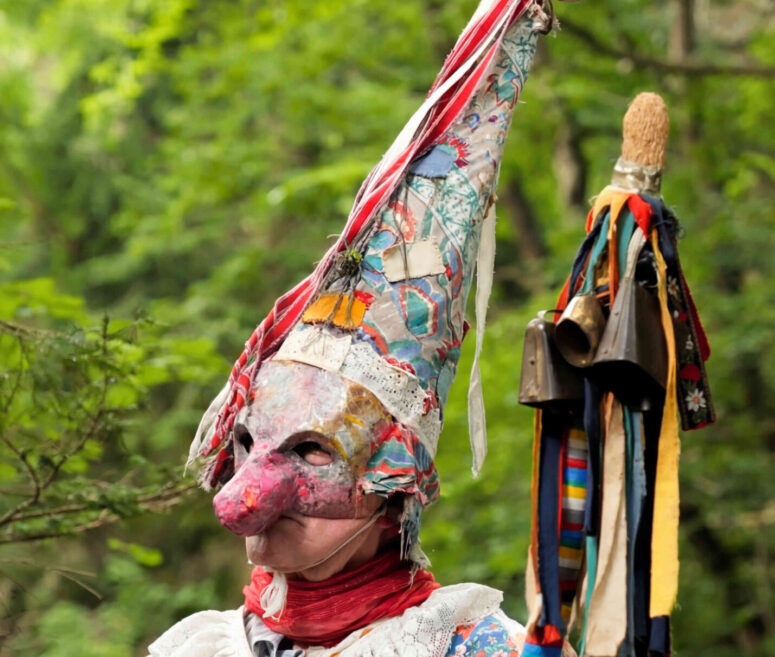
Bergamo therefore represents the non-built world as opposed to the city, a desert to visit in order to regenerate oneself, but it also represents the possibility of coming into contact with wonder. The porters of Bergamo were described as rough, apelike people, unable to speak properly, with little brainpower, but great workers. Tommaso Garzoni writes that the people of Bergamo have more than donkey-like appearances and virtues. We are used to thinking that the donkey is synonymous with ignorance, but the donkey is famous above all for its sexual virtues—and herein also lies an allusion to the porters of Bergamo—but it also has prophetic virtues. In Dossena, the mask of the donkey was the one that intervened to reveal prophecies, to unveil what would happen. After all, wearing a mask means just that: renouncing everyday life, renouncing one’s identity to open oneself up to the unknown, embarking on a journey.
ADELE DIPASQUALE
Yes, in fact during our residency we had the chance to see the donkey mask and costume, and we thought it was amazing. In general, however, it is not easy to understand how to view the traditions of the past, considering that the global context has changed so much: communities are disintegrating, family institutions are falling apart, and work has undergone radical changes. We wondered about the role that such a festival can play today.
I’ll give an example that we were told about and which I find illustrative. One year, during a masquerade, a case of rape that had taken place in the village was reenacted, thus satirizing a clerical figure who had been accused of the rape. It seemed to us to be a powerful tool for direct democracy, but also a way of practicing politics that goes beyond state institutions or the standard mechanisms of democracy. In general, gender seemed to be a hot topic in the village, where there is a lively conflict between the older and younger male populations. We learned, for example, that the masquerades were exclusively male, i.e., that all the roles were played only by men, even the female ones. I think this is an interesting question to ask, because even if we talk about the festival as a moment of alteration and reversal of roles, we know very well that it still takes place within patriarchal structures that allowed only a section of the male population to experience this exhilaration. In our project, we try to include this interpretation of masquerades within a much broader and more complex system of power and gender roles, a system that is currently undergoing drastic change on a global level.
Another aspect that interested us concerns the places where the masquerades took place and how these have changed over time. Initially, masquerades took place in all districts, moving from one street to another, and this was an opportunity to meet people from other neighborhoods. Later, the masquerades moved to the town square in front of the church, one of the most important institutions in the town.
ROBERTO CASTI
I would also like to add another point that we have debated at length. Festivals, in this case a carnival, are a moment of suspension where there is room for satire and the critique of power and government. Order is questioned, rules are subverted, and during the festival it is acceptable to speak ill of one’s master. Festivals represent a moment of reappropriation of the public space. I wonder whether there are still celebrations today that have this power of subversion, of questioning the hegemonic system, of criticism and, at the same time, of collective action to reclaim the public arena.
ALESSANDRA MIGNATTI
You have raised some huge issues. However, I have my doubts about carnival as a moment of social criticism—and, in general, about festivals as moments in which radical social criticism may be expressed. In the case of the rape that Adele mentioned, the fact of representing it, i.e., of “making it present again” through fiction, implies being able to control it. Think of a child playing at being a mom, dad, or teacher—that is, trying to impersonate figures who can say no to them, who can scold them. When they represent these figures, they make them their own, control them, and are no longer afraid of them. To make this example more explicit, Freud’s essay on little Hans is always cited. When his mother goes out, Hans plays with a spool of thread, pushing it away and pulling it back to him, symbolizing his mother going out and him being able to bring her back to him, thus controlling this fact and overcoming his fear. In children’s play, we find the mechanisms of representation reflected perfectly. Representing something negative that a community has experienced serves to make it present in order to accept that it has happened and thus to overcome it. These systems, such as carnival, represent the crisis and contain within them the mechanisms to overcome the moment of crisis.
The carnival is one of those festivals where it is okay to go mad, to go over the top, beyond the limits. Chaos is necessary because only from chaos can new things arise, and deities and spirits can be revealed. Sticking with work in the fields, it is only when the soil is turned over that it can be resown. Festivals and carnivals are always characterized by excess, whether it be an excess of food, of movement, lights, vulgarity . . . It’s always something that goes further. So yes, it is true that the carnival overturns the established order and power—there was the mock bishop, the mock king—but then the political or religious system went back to being exactly the same.
As for Dossena, it is true that over time the carnival has largely lost its traveling dimension. First, as Adele said, it would tour from neighborhood to neighborhood, then it was held in front of the church (but note that when theater left the churches, it was first moved to the churchyard before moving into specially built theaters). Originally, in traditional carnivals, Zanni went stealing from house to house, which was a way of sowing chaos in the village only to then re-sacralize it. In this sense, I don’t think there’s a form of direct democracy in carnival. Carnival serves to overcome a fact, not to subvert it. The order is reversed so that everything goes back to the way it was before. Human beings need these moments to maintain balance, to avoid going mad, and to avoid the risk of a real revolution, albeit in a disorganized manner.
Carnival is part of the new year’s rituals, when the new world must be reborn. And to be reborn, chaos is needed. Masks bring chaos because they erase identity and always refer to something different, not commonplace, something that lies in the shadows. Often, moreover, they are connected to beings that come from underground and bear the names of animals or spirits.
What’s more, in our culture, the dead rest where seeds are sown, where fertility and the wellbeing of society come from. As ours is a society with peasant roots, there is a strong link between the world of the dead and fertility, which masks somehow evoke. Carnivals and masks are based on the idea that, according to the astral calendar, once the toil in the fields is over and the animals have gone into hibernation, nothing more can be done materially, and it’s therefore necessary to propitiate the new harvest through specific forms of prayer and ritual.
The cult of the dead is still strong in our traditions: in Sicily, it’s the dead who bring gifts to children; in Bergamo it is Santa Lucia; while in Sardinia there is animeddas, an ancient tradition to commemorate the dead that is similar to Halloween, in which tables are laid for the deceased, while children dress up as animeddas and go from door to door to collect gifts. Children are the closest beings to the spirit world, to the world of the dead.
Added to this is the issue of sexuality, which is closely connected to the dead and, once again, to the fertility of the land. Male fertility was also linked to that of the fields: in a peasant civilization, having many children meant having more hands to till the land. In this sense, we find a series of typically male sexual attributes in Zanni, who has many of them on display and in his stories. Masks such as those of Zanni are linked to compositions such as mariazi, created for weddings, or charivari or scampanate, linked to cohort celebrations, i.e., the male population that is about to come of age. Scampanate are still used today during weddings and consist of noise, chaos, or jokes played on the young couple the night before or on the day of the wedding. However, scampanate originated as a form of social control, when a marriage between an older and a younger person was sanctioned, with direct repercussions on the fertility of the group. It is well known that two young people can have more children than an older person, whose fertility undoubtedly diminishes, with repercussions on the well-being of the entire community.
Likewise, the scampanata also condemned cases in which a boy or girl was taken away by a partner from another village. There are also many iconographic representations of Zanni following Pantalone, a rich old man who tries to seduce and marry a young girl. Pantalone is depicted riding a donkey backward, in a total reversal. And what does Zanni do? He blows air into the animal’s rear with big bellows, so that the animal emits a loud flatulence and Pantalone is mocked. In the canovacci, or the fixed scene frameworks of the commedia dell’arte, when marriages between young and old must be prevented, the servants cause chaos and confusion with their foolishness, so that in the end the old men are prevented from marrying the young girls. In this way, families can continue to grow, vegetation can continue to flourish, and animals can continue to reproduce. It should also be noted that the Zanni figures in the commedia are idlers, they make quite a fuss but achieve very little. Far from being hard-working Bergamasques, far from being self-sacrificing! They just want to fill their bellies and make love. There are usually two servants: one of them is more dutiful, but as Nicoll says, “It’s hard to say which of the two is the least stupid and which is the most cunning.”
ADELE DIPASQUALE
I’d like to go back to the idea of exhilaration associated with the festival, with the alteration and excess that I find very interesting. In this regard, I’d also like to mention one of the first instances of friction between us and the population of Dossena. During an exchange, we were talking about the Alpini with a local man who had a trusting relationship with this military corps. This person was very struck by the story of an experience I had when I was sixteen in Turin, the city where I lived and where the Alpini’s national gathering was taking place that year. For the first time, I saw my city change. Over those days, the rules were overturned, and a portion of the Italian male population was allowed to come into the city and find a series of spaces and people at their disposal, both verbally and physically. This was tolerated by the local authorities, who were much more restrictive with other types of celebrations. For me, this is a rather illustrative example of what celebrations can be like today and what it means to have moments of chaos and upheaval available to us.
VALENTINA GERVASONI
The example you give also shows how collective celebrations can become expressions of belonging to a particular group with which you share a specific system of codes and values. With regard to the topics discussed so far, can you tell us what your projects for Dossena consist of and which figures and masks you included?
ADELE DIPASQUALE
Our work in Dossena involves an initial workshop phase in which we write a song with various segments of the population, speaking of their relationship with the past, present, and future of the place. The song will then be heard by the population through an installation in the village, created through a participatory process using waste material from the mine, which has been at a standstill for many years now. A performer will then reinterpret this song wearing various masks (Harlequin, the homo salvadego or Wild Man, the Old Woman, the Donkey, Death) and rearranging the verses so that the chronological order is disrupted, in order to create a nonlinear narrative of the place. The video is shot inside the mines, a place that symbolizes the shadows and where darkness is not only a physical factor but also a metaphorical one, in a reference to Dossena’s more complex and sometimes dramatic past. In this sense, I find what Alessandra said very interesting, something we had not yet focused on so precisely: the mask as a figure of shadow, the relationship between the world of the dead and that of the living, and children as liminal figures between what was before and what is yet to come.
IRENE GUANDALINI
You mentioned the mine as one of the aspects that struck you most. The mine is still a central part of life in Dossena, the repository of a complex heritage that is still very much alive. It has provided work for entire generations of workers, allowing them to live (or at least survive) in conditions of poverty to which they would otherwise have been condemned. However, working in the mine was physically grueling, leading to deaths, injuries, and fatal respiratory diseases. Despite the environmental and physical exploitation of the workers, a narrative was created and legitimized that revolved around the concept of a necessary and somehow ennobling sacrifice, even though it was destructive. During your residency and research, what kind of relationship did you find today between the inhabitants of the village and the mine? Thinking also about the tradition of the songs of the miners of Dossena, a vocal expression of a particular world-system, do you believe listening can be a form of collective thought?
ROBERTO CASTI
Right from the very beginning, as Adele said about the festival, we understood that there is a strong culture linked to music and that sound is part of the community’s DNA. We found the use of various popular musical instruments (such as the accordion or guitar) and orchestral instruments, but also a major use of singing, which is in fact the language we decided to focus on most. During the research phase, we were fortunate enough to hear several songs performed live—often focused on mining work—some of which were performed by relatives or friends of former miners who had died from respiratory diseases. On these occasions, the singing had the power to bring to light some of the traumas of the past, and it was incredible to hear the voices of those who carry this memory with them. This is why singing was the language we immediately identified as the most suitable.
Our idea was to come up with a new song, because we want the work to have a temporal dimension, linked to the past but also to the present and the future. We would like this piece to bring out the history of the inhabitants, including their traumas; the legacy that this past has on the present, on what it means to live in Dossena today; and the future that lies ahead with the challenges that the village will have to face, from issues related to depopulation to environmental problems and changes in working practices. We would therefore like to create an intergenerational narrative through a fragmented song, made up of the voices of children, the parish choir, and former miners from the village. A story that transcends time and speaks of the community.
Once the song has been recorded, it will be installed in a public space. As Adele said earlier, the meeting place that will serve as a listening area for the song—consisting of a few benches and a community garden—will be made of waste materials from the mines, namely stones that were extracted and discarded over time as they have no economic value. People will be able to meet, use the plants in the garden, look at the landscape, and wait for the song to be played. The song will mark the passing of the day: one verse will be played at dawn, another at noon, and the last at sunset, when the streetlights come on.
The mine waste is also an important catalyst for us to talk about the relationship with work and the rhetoric of sacrifice associated with it. The recycled materials are the fruit of past sacrifice but never entered the economic process. On the contrary, they were left around the entrance mine, stratifying and thus creating a new natural landscape. We would therefore like to use these stones that, although of no value for the human extractive machine, certainly constitute important symbols for those who worked down the mines. We decided to use them to create something for the community.
VALENTINA GERVASONI
There is a particular interest in your work and artistic practice in sound, voice, and speech. You view them as devices that can be attractive at times and frightening at others. If you had to define sound as a political space, what kind of space would it be?
ADELE DIPASQUALE
I have been working on voice and the relationship between voice and language for a number of years. Normative language, as we have historically received it, is often a tool of oppression, control, and the definition of identities that are restrictive and hard to shake off. Recently, I have focused mainly on how the voice can be used to expand or break out of preestablished categories and rewrite new languages through orality, non-verbal languages, and all those forms of communication that have not been historically validated in any way. The goal is therefore to break away from structures of oppression and power and give voice to silenced and suppressed voices in order to amplify them. To favor polyphony over single, all-encompassing narratives.
IRENE GUANDALINI
There is a specific aspect of your artistic research, Adele, that concerns magic as a literary genre and its relationship with poetry and the words it evokes. Characterized by a language that alludes rather than explains, magic spells open up to the unknown, the mysterious, sometimes connected to the afterlife, in general to what we cannot control or fully know and possess. Magic spells have the power to affect reality and make something happen; in other words, they have performative power. In this regard, you have spoken in the past about the language of insubordination, meaning magical words as forms of resistance to contemporary hegemonic epistemology. This is an aspect that opens up a discourse that is, in a certain sense, more esoteric, one of connection with spirits and an afterlife, which seems to me to resonate perfectly with what Alessandra was saying earlier about masks.
ADELE DIPASQUALE
My interest in the word “magic” stems precisely from its ability to have a real effect. So I say, and by saying I produce an action, I create a result. The second line of interest in my research is to think about mediumistic practice, the idea of becoming the body for another voice. It is a methodology that I think also works when applied to the artistic practice, where the artist—through herself or her body of work—embodies these polyphonies and becomes their vehicle. I am very interested in the fact that it is also an embodied practice and not just a theoretical one, and that it has to do with a type of experiential knowledge linked to the senses, i.e., not exclusively logical and rational.
Finally, the third line of interest concerns thinking of magic as another order of reality. We tend to accept very abstract concepts as valid and real, such as borders, money, or identity cards, all of which are theoretical elements that nevertheless have a real impact on people’s lives, with material consequences. On the other hand, we think of spirits or angels as unreal. This is a division between systems of reality validated by linguistic divisions. In this case, for me, magical thinking brings to light how much the product of today’s society is actually the product of a linguistic division. The word “magic” has the power to question what we consider to be reality.
ALESSANDRA MIGNATTI
To conclude, I would like to refer back to what Roberto said about singing, because singing, especially choral singing, leads to a shared breath, and induces the same breath in those who listen. And this leads to community-building. We are in the realm of non-communication, where the most important thing is not to send a message but to communicate. Being in song leads to enchantment—that is, to being able to marvel. Singing as a vehicle was explored by the great theater master Jerzy Grotowski, according to whom the actor—whom he calls the performer—is someone who goes beyond things, capable of making a different reality vibrate and, like a sort of elevator, leads to the accessing of primal forces.
This is a vision that brings us very close to the subject of masks. Anyone who has tried wearing one knows that a mask is a force that draws you in, completely changing both your body structure and your ability to speak. You must first listen to the mask in order to eventually master it and not be overwhelmed by its spirit. I find this work on singing very interesting for this reason, because it can bring about an experience of knowledge and personal transformation solely through true vibration. Masks, like singing, can do this, both when they make us laugh and when they scare us. This is important. Even before the messages we want to convey, we must act on people by creating community.
Only if we rediscover a stronger sense of community can we truly overcome divisions and create something new. But first, in my opinion, we need to mend many layers. And singing can do this because, by talking about the past, it has the opportunity to talk about the future. Likewise in carnivals, there was always someone who made prophecies, and it should be noted that the prophecies foretold nothing more than what was already known, but it was still comforting to think the world would go on.
So we welcome the word that goes beyond the word, the voice that goes beyond the thing. Peter Brook says that in theater, the message is secondary; the relationship between people and being together come first. Rediscovering this in the work done in Dossena is wonderful, and I am very happy you’re doing it. This is the way to rediscover the authenticity of the mask, to recall one reality from another.